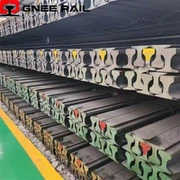
Which container to use for S10 Steel Rail: 20ft or 40ft?
May 25, 2026

Which container to use for S10 Steel Rail: 20ft or 40ft?
For shipping DIN S10 light steel rails, a 20ft container is almost always the optimal and most economical choice, provided you are ordering the rails in their standard 6-meter fixed lengths.
Understanding why a 20ft container works best-and the rare exceptions where a 40ft container is necessary-depends on analyzing the relationship between rail length, total cargo weight, and structural loading limits.
Why a 20ft Container is Best for 6-Meter S10 Rails?
Steel rails are dense, heavy cargo (known as "heavy cargo"). When shipping them, you will hit the container's maximum weight capacity long before you run out of physical space (volume).

- Perfect Length Alignment: A standard 20ft container has an internal length of 5.898 meters. A standard 6-meter S10 rail actually measures exactly 6.000 meters. Because rails are packed tightly at an angle or loaded slightly offset within the door clearance tolerances, standard 6-meter bundles are specifically manufactured to fit into 20ft containers without wasting container length.
- Maximizing Weight Capacity: A standard 20ft container has a maximum payload capacity of approximately 21.5 to 25 metric tons (depending on the shipping line and destination road weight limits).
- High Yield Efficiency: Because S10 rail weighs 10.00 kg/m, a single 6-meter rail section weighs 60 kg. Loading a 20ft container to its maximum 24-ton capacity allows you to fit 400 pieces of 6-meter rails.
What are the Precise Internal Dimensions and Loading Limits for Rail Containers?
Understanding the exact physical dimensions of ocean freight containers prevents costly customs delays and on-site loading complications. When planning a shipment of light weight DIN 5901 Rail Track bundles, logistics managers must analyze internal clearances and maximum structural weight limits to ensure the cargo can be loaded safely using standard heavy forklifts.
The precise physical parameters for standard maritime containers used to transport S10 Steel Rail segments are listed in the table below:

| Container Type | Internal Length | Internal Width | Internal Height | Max Max Payload Weight | Optimal S10 Rail Length |
| 20ft Dry Van (DV) | 5,898 mm | 2,352 mm | 2,393 mm | ~25,000 - 28,200 kg | 5,800 to 5,850 mm |
| 40ft Dry Van (DV) | 12,032 mm | 2,352 mm | 2,393 mm | ~26,500 - 28,800 kg | 6,000 to 11,800 mm |
To maximize a 20ft container, we recommend ordering S10 Rail Dimensions finished at 5.8 or 5.85 meters, which allows the bundles to slide cleanly straight through the door frame, fully utilizing the maximum weight payload without paying for the empty space of a 40ft container.
What are the Main Strategic Advantages of S10 Rail Container Optimization?
Optimizing how your rail bundles are packed into standard ocean containers yields immense economic and mechanical advantages over haphazardly ordering random lengths that force inefficient shipping methods. The specific Advantages of S10 Rail cargo planning guarantee sustained material safety and minimal logistical overhead.
The core transport advantages realized by choosing the proper container layout include:

- Drastic Ocean Freight Savings: Trimming rails to fit 20ft containers can reduce ocean freight rates by up to 30% per ton compared to under-utilizing a 40ft container for short lengths.
- Simplified Port Handling: Standardized containerization allows for rapid crane discharging at global ports, completely avoiding the expensive terminal handling fees associated with loose breakbulk cargo.
- Maximum Mechanical Protection: Stowing rails in fully enclosed dry vans shields the steel from direct saltwater exposure and prevents bending stress during rough transits.
Frequently Asked Questions
- Can a standard 6-meter S10 rail fit horizontally inside a 20ft container?
No, a standard 6-meter (6,000 mm) rail cannot fit horizontally in a straight line because the internal length of a standard 20ft container is exactly 5,898 mm. To utilize a 20ft container safely and efficiently, the rails must be precision-cut at our factory to a maximum length of 5,850 mm, leaving sufficient clearance for the door locks and protective timber bracing.
- Is it more expensive to ship S10 rails in 40ft containers if the total weight is the same?
Yes, ocean freight rates for 40ft containers are generally higher than 20ft containers, even if the cargo weight is identical. Because steel is a high-density, low-volume cargo, you will hit the container's maximum weight limit (~26 to 28 tons) long before filling the volumetric space. If your project can accept 5.8-meter lengths, using a 20ft container provides a significantly lower freight cost per ton.
- How many bundles of 5.8-meter S10 rails can be loaded into one 20ft container?
Every standard bundle of S10 rails typically contains 40 pieces tightly bound together, weighing approximately 2.34 metric tons per bundle. To stay within the standard 24-to-25-ton maritime weight limit for a 20ft container, we load exactly 10 to 11 bundles, resulting in 400 to 440 individual rail lengths per container shipment.
- What happens if my project strictly requires exact 6-meter lengths?
If your engineering prints strictly require exact 6-meter lengths and cannot accept a 5.85-meter trim, the cargo must be loaded into a 40ft container. Alternatively, if your order volume is large enough (typically over 500 tons), we can arrange specialized breakbulk vessel shipping, where the rails are stowed directly in the ship's cargo hold without using containers.
Get a Quote in 24 Hours
Our advanced steel mills process a comprehensive range of international standard configurations, allowing us to supply premium S10 light rail systems alongside a full inventory of matching joint bars, high-tensile track bolts, elastic anchoring clips, and custom base plates tailored precisely to your engineering prints. Our dedicated export logistics and quality control teams directly manage every phase of steel refining, automated straightness checking, container packing, and maritime clearance to guarantee full heat traceability, strict compliance with DIN 5901 dimensions. Contact the GNEE RAIL logistics division today to evaluate your track infrastructure layouts, access detailed container stuffing diagrams, and secure an authoritative, factory-direct wholesale quotation to optimize your global procurement budget.