


What are the main differences between S24 steel rail and S20 light rail?
Apr 27, 2026
What are the main differences between S24 steel rail and S20 light rail?
The primary differences between S24 steel rail and S20 light rail lie in their linear mass and vertical stiffness. While both belong to the DIN 5901 standard, the S24 rail has a theoretical weight of 24.43 kg/m, making it approximately 23% heavier than the S20 rail's 19.80 kg/m. This additional mass allows the S24 to support higher axle loads, typically up to 5 tons, compared to the 3.5-ton limit of the S20.
Detailed Comparison
Weight:
- S24 Rail: Typically has a theoretical weight of 24.4 kg/m.
- S20 Rail: Typically has a theoretical weight of 19.8 kg/m.

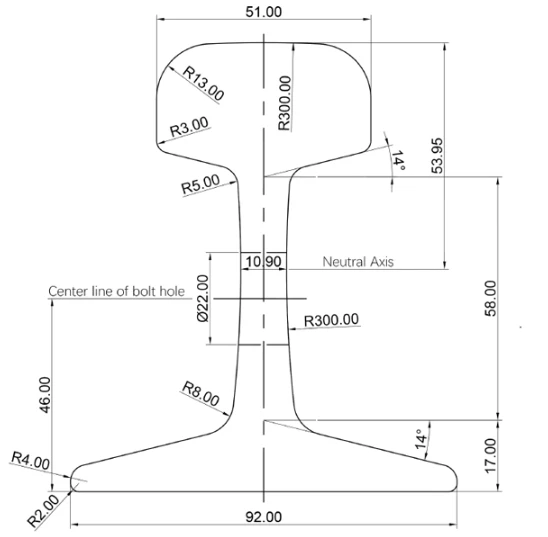
Dimensions (DIN 5901):
- S24 Rail: Features a higher profile, generally with a height of 115mm, a bottom width of 90mm, a 53mm head width, and 10mm web thickness.
- S20 Rail: Has a smaller cross-section compared to the S24, optimized for lower-load scenarios.
| Size | Rail height(mm)
A |
Bottom Width(mm)
B |
Head Width(mm)
C |
Web Thickness(mm)
t |
Weight(kg/m)
* |
| S10 | 70 | 58 | 32 | 6 | 10 |
| S14 | 80 | 70 | 38 | 9 | 14 |
| S18 | 93 | 82 | 43 | 10 | 18.3 |
| S20 | 100 | 82 | 44 | 10 | 19.8 |
| S24 | 115 | 90 | 53 | 10 | 24.4 |
| S30 | 108 | 108 | 60.3 | 12.3 | 30.03 |
Load-Bearing Capacity:
- S24 Rail: Designed for medium-load applications, such as heavy-duty mining carts, industrial logistical lines, and port cranes.
- S20 Rail: Suited for lighter-duty applications, such as factory floor logistics, light crane runways, and temporary construction tracks.
Applications:
- S24: Better suited for permanent installations where slightly higher traffic volumes or axle loads are expected.
- S20: Ideal for tighter spaces or temporary transport systems where lighter material is required for easier handling.
How do Load Capacities Differ Between These Rail Types?
The S24 rail load capacity is engineered for medium-duty industrial applications, whereas the S20 is strictly for light-duty use. The 24.43 kg/m weight of the S24 allows for an axle load increase of nearly 1.5 tons over the S20.

This makes the S24 suitable for larger overhead cranes and heavier underground locomotives. In automated warehouse systems, the S24 is often chosen when the shuttle cars carry heavier pallet loads or when the support spacing between racking beams is wider, requiring a rail with higher vertical rigidity to prevent track "sagging."
How to choose the right type of rail?
Choosing the right rail profile is a balancing act between load requirements, frequency of use, and budget. Selecting a rail that is too light leads to frequent breakage and derailments, while one that is too heavy results in unnecessary procurement and installation costs.
To select the correct type, evaluate these four primary technical factors:
1. Axle Load and Carrying Capacity
The most critical factor is the maximum weight each wheelset will exert on the rail.
- Light Rail (e.g., S18, S20, ASCE 30): Best for axle loads under 5–8 tons. Used typically in mining, tunneling, and light industrial plants.
- Medium Rail (e.g., 30kg/m, 38kg/m): Suitable for loads between 10–20 tons. Common for regional freight and heavy factory cranes.
- Heavy Rail (e.g., UIC60, 136RE): Designed for axle loads of 25–35+ tons. These are standard for national freight and high-speed passenger lines.
2. Operating Environment and Standards
Rail types are manufactured to specific regional and industrial standards. You must ensure your rolling stock (wheels) is compatible with the rail head profile.

- DIN 5901 (S-Series): The European standard for industrial and mining tracks. If your project is in Europe or uses European machinery, S20 or S30 are common choices.
- ASCE (American Society of Civil Engineers): Widely used in North and South America for light industrial applications.
- UIC / EN Standards: The global benchmark for heavy-haul and high-speed infrastructure.
- Corrosive Environments: If working in damp mines or chemical plants, focus on the metallurgy (e.g., higher manganese content) rather than just the weight.
3. Installation Type: Permanent vs. Temporary
How you plan to lay the track dictates the rail's weight and flexibility.
- Portable Tracks: For construction sites or temporary forestry lines, lighter rails like S18 or S20 are preferred because they can be manually handled and moved without heavy machinery.
- Fixed Infrastructure: For permanent factory lines or crane runways, heavier rails with wider bases (foot width) are chosen to provide long-term stability and reduce maintenance cycles.
FAQ
Q: Can I use S24 rail joint bars on S20 rails to make them stronger?
A: No, the holes will not align, and the fishplate will not seat in the fishing space. A mismatched S20 rail joint bar will create a loose connection, leading to the rapid failure of the 7.00 mm web and potential derailment of your machinery.
Q: Is the price per ton significantly different for S24 vs. S20?
A: The price per ton is usually similar as they are both hot-rolled DIN 5901 rails. However, your total project cost will be higher with S24 because you are buying more steel mass (24.43 kg/m vs. 19.80 kg/m) to cover the same distance.
Q: Why choose S20 if the S24 is stronger?
A: The S20 is chosen for its 19.80 kg/m weight, which is easier to handle manually and more cost-effective for light-duty applications like 3.5-ton axle load mining cars or small workshop cranes where the extra strength of the S24 is unnecessary.
Q: Are the expansion gap requirements the same for both?
A: Yes, both require a 2–4 mm expansion gap within their respective joint bars. However, because the S24 is a larger thermal mass, it may exert more force on the fasteners during extreme temperature shifts, requiring more robust rail clips on the 90.00 mm base.
Q: Can GNEE RAIL provide both S24 and S20 from the same facility?
A: We manufacture the full range of DIN 5901 rails, including S18, S20, S24, and S30. We provide precision CNC drilling and cutting for both types, ensuring that your S24 and S20 rail drawing specifications are met with sub-millimeter accuracy for global export.
Get a Quote in 24 Hours
GNEE RAIL provides DIN 5901 S20 and S24 rails, full-size crane rails (QU, A series), and international standards like ASCE and JIS directly from our manufacturing facility. We supply all matched S20/S24 rail joint bars, high-tensile bolts, and rail clips to ensure your track system is fully compatible. Our CNC workshop handles precision cutting and custom drilling to your exact rail drawing specifications. Send your technical requirements to GNEE RAIL now to receive a detailed quote and CAD support for your upcoming project.


