How do rail anchors work?
Jan 04, 2026
How Do Rail Anchors Work?
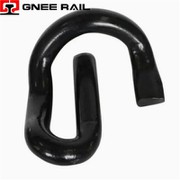
A rail anchor, also called a railroad anchor or railroad tie anchor, is placed under the rail base and clamps the rail with its curved design, while its side is pressed against the sleeper. Rail anchors are made in one piece from spring steel, which lets them fasten the rail by providing friction, elasticity and a locking action.
Rail creep is the slow longitudinal movement of the rail caused by thermal expansion, braking and traffic forces. If left uncontrolled, creep pushes the rail along the sleepers, disturbs the rail joints and sleeper spacing, and damages the track. The rail anchor stops this movement by transferring the longitudinal force from the rail to the sleeper and, through it, to the ballast.
Key Working Mechanisms
Clamping Action
The anchor grips the rail base and is driven or pressed until it is tight against the sleeper, providing a large bearing surface. The clamp is what keeps the anchor in place under continuous service loads.
Friction and Resistance
When the rail tries to move, the anchor creates significant friction against the rail base and against the sleeper. The resistance of the sleeper, held by the ballast, stops the rail from sliding.
Elasticity
The spring steel construction allows the anchor to maintain pressure and adapt to minor rail movements, ensuring continuous contact. Because the anchor returns to shape after deflection, the clamping force stays constant for a long service life.
Force Transfer
The anchor transfers the rail's shifting forces to the sleeper, preventing the sleeper from moving along the track axis and distributing the stress over the trackbed. Box anchoring, where sleepers are anchored on both sides, distributes the load evenly over a group of sleepers.
Typical Anchor Specification
| Item | Detail |
|---|---|
| Suitable rails | 50 kg/m, 85 kg/m, 90/91 lb/yd, 115RE, 136RE, UIC54, UIC60, or other sections per customer drawings |
| Materials | 60Si2MnA, 45#, QT500-7 |
| Chemical composition | 60Si2MnA: C 0.56-0.64, Mn 0.60-0.90, Si 1.60-2.00, Cr max 0.35, P max 0.03, S max 0.03; 45#: C 0.42-0.50, Mn 0.50-0.80, Si 0.17-0.37, Cr max 0.25, P max 0.035, S max 0.035; QT500-7: C 3.60-3.80, Mn max 0.60, Si 2.50-2.90, P max 0.08, S max 0.025 |
| Surface treatment | Plain (oiled), colour painting, zinc painting or hot-dip galvanizing |
| Standards | AS 1085.10-2002, DIN-based designs, ISO 9001 quality system |
How to Install a Rail Anchor
Correct installation is essential for the anchor to develop its full clamping force:
Position the track anchor on the measuring surface of the rail base against the same engaging surface on the opposite rail, so the pair of anchors works together.
Ensure the track anchor securely grips the rail base and has complete support at the rail joint.
When the anchor on a sleeper is worn by interference, replace both the railway anchor and the rail to restore full grip.
Do not move anchors by driving them along the rails; reposition them by lifting and refitting.
When anchors are applied, the rail and sleeper should be straightened first so the bearing faces meet evenly.
FAQ
What does a rail anchor do?
A rail anchor clamps onto the base of the rail and presses against the sleeper to prevent the rail from moving lengthwise, a movement called creeping, caused by thermal expansion, braking and traffic forces.
How does a rail anchor hold the rail?
It combines four mechanisms: clamping onto the rail base, friction against the rail and sleeper, elasticity of the spring steel, and transfer of the rail force into the sleeper and ballast.
Why is spring steel used in rail anchors?
Spring steel returns to its original shape after deflection, so the anchor maintains constant pressure and adapts to minor rail movements without losing grip or needing re-tightening.
What is box anchoring?
Box anchoring means fitting anchors on both sides of a sleeper so the rail is locked in both directions. It is used at intervals along the track to distribute longitudinal forces over many sleepers.
What happens if rail anchors are installed incorrectly?
An incorrectly installed anchor develops less clamping force, allowing the rail to creep, which can cause uneven rail gaps, skewed sleepers and damage to the track. Anchors should be lifted and refitted, never driven along the rail.