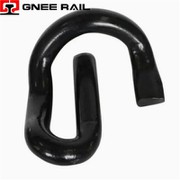
Main Types of Rail Clips: Spring Clip Models, Materials and Applications
Sep 29, 2025
What a rail clip does
A rail clip, also called an elastic rail clip, is the component that fastens the steel rail to the underlying tie plate or sleeper shoulder. The clip is deflected during installation so that it applies a spring pressure on the rail foot. Through its bending and elastic distortion, the clip holds the rail down and resists longitudinal movement of the rail, whether that movement comes from temperature change, braking forces or vibration.
Rail clips are made of forged spring steel produced by a hot forging process. Because hot forging produces a uniform microstructure, forged rail clips are generally considered to give more consistent performance than clips made by other metal forming processes. The spring steel is heat treated to give the clip its elasticity, and the clip is designed so that its working range keeps the clamping force within a defined band over the service life.
Main clip types and dimensions
| Clip type | Diameter | Weight | Material |
|---|---|---|---|
| Type III clip | Ø18 | 0.80 kg/pc | 60Si2MnA |
| E1609 (E-type) | Ø16 | 0.43 kg/pc | 60Si2MnA |
| E1809 (E-type) | Ø20 | 0.61 kg/pc | 60Si2MnA |
| E1813 (E-type) | Ø18 | 0.62 kg/pc | 60Si2MnA |
| E2001 (E-type) | Ø20 | 0.80 kg/pc | 60Si2MnA |
| E2007 (E-type) | Ø20 | 0.80 kg/pc | 60Si2MnA |
| E2009 (E-type) | Ø20 | 0.80 kg/pc | 60Si2MnA |
| E2039 (E-type) | Ø20 | 0.80 kg/pc | 60Si2MnA |
| E2055 (E-type) | Ø20 | 0.80 kg/pc | 60Si2MnA |
| E2056 (E-type) | Ø20 | 0.80 kg/pc | 60Si2MnA |
| E2063 (E-type) | Ø20 | 0.80 kg/pc | 60Si2MnA |
| Heavy-duty clip (PR85 type) | Ø13 | 0.25 kg/pc | 60Si2MnA |
| Heavy-duty clip (PR309A type) | Ø19 | 0.85 kg/pc | 60Si2MnA |
| Heavy-duty clip (PR401 type) | Ø20 | 0.97 kg/pc | 60Si2MnA |
| Heavy-duty clip (PR415 type) | Ø20 | 0.95 kg/pc | 60Si2MnA |
| Heavy-duty clip (PR601A type) | Ø20 | 1.03 kg/pc | 38Si7 |
| Type 1 clip | Ø13 | 0.48 kg/pc | 60Si2CrA |
| Type 3 clip | Ø13 | 0.48 kg/pc | 60Si2CrA |
| Type 12 clip | Ø13 | 0.53 kg/pc | 38Si7 |
| Type 14 clip | Ø13 | 0.53 kg/pc | 60Si2MnA |
| Special rail clip | Ø13 | 0.48 kg/pc | 60Si2MnA |
| Russian-standard clip | Ø18 | 0.58 kg/pc | 60Si2MnA |
| Heavy section clip | Ø25 | 0.49-0.68 kg/pc | 60Si2MnA |
| Single anti-theft clip | Ø20 | 0.25 kg/pc | 60Si2MnA |
Clip types explained
E-type elastic rail clips
The E-type clip family (designations such as E1609, E1809, E1813, E2001, E2007, E2009, E2039, E2055, E2056, E2063) is the workhorse of modern fastening systems on concrete sleeper track. The clip is driven into a shoulder or insert and grips the rail foot with a defined toe load. The four-digit designation identifies the bar diameter and the length class; the clip is selected to match the rail section and the fastening system.
Heavy-duty spring clips
Heavy-duty clips with larger bar sections (for example the PR-type series from 0.85 kg to 1.03 kg per piece) provide higher toe loads for heavy-haul and high-axle-load lines. They are used where the standard E-type clip does not develop enough clamping force for the track category.
Type 1 / Type 3 / Type 12 / Type 14 clips
The 13 mm diameter clip family (Type 1, Type 3, Type 12 and Type 14) is used in fastening systems with a 13 mm clip bar, distinguished by the clip geometry, the toe load and the shoulder type. Materials include 60Si2CrA, 60Si2MnA and 38Si7 spring steels, selected for the fatigue life required by the fastening system.
Special-purpose clips
Special rail clips, Russian-standard clips, heavy section clips and single anti-theft clips cover particular markets and duties: anti-theft clips lock the fastening against removal, and heavy section clips carry the highest loads on crane and industrial track.
Materials and quality
Clip materials are spring steels: 60Si2MnA and 60Si2CrA for the standard range and 38Si7 for the highest-strength types. The steel is hot forged, heat treated and stress relieved so that the clip returns to its designed geometry after deflection. Quality control includes hardness testing, toe load verification and fatigue sampling, because a clip that loses its elastic force silently reduces the holding power of the whole fastening system.
Frequently Asked Questions
What is the difference between a rail clip and a rail spike?
A rail clip is a spring component that presses the rail foot down with elastic force and is usually used with a shoulder or insert on concrete sleepers. A rail spike is driven or screwed into timber sleepers. The two are used in different fastening systems.
How is a rail clip selected for a fastening system?
The clip is selected by the rail section, the fastening system design and the required toe load. The clip geometry and bar diameter must match the shoulder or insert, and the toe load must satisfy the track category and axle load.
Why is the clip material important?
The clip works by elastic deflection, so the material must have high yield strength and fatigue resistance. Spring steels such as 60Si2MnA give the clip a long fatigue life under millions of wheel passages.
What does the number in an E-type clip designation mean?
The four-digit designation identifies the clip within the E-type family, principally by bar diameter and length class, which set the toe load and the geometry of the fastening. The clip is matched to the shoulder and rail section in the system design.
Can clips be reused after rail changing?
Clips can be reused if they are straight, within dimensional tolerance and show no cracks, but most operators fit new clips when the fastening is re-built, because clip fatigue life is finite and a new clip guarantees the designed toe load.
What fasteners are used together with rail clips?
A complete rail seat includes the clip, a shoulder or insert holding the clip, a rail pad under the rail foot, and often a tie plate. Screw spikes or bolts fix the assembly to the sleeper, and fishplates and anchors handle the joints and longitudinal restraint.