what are the type of defects in rails?
Jan 22, 2026
What is Steel Rail?
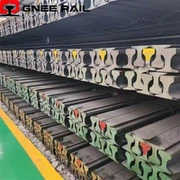
Steel rail (also called railroad rails, railway tracks, or crane rails) are the fundamental components of track systems, serving to guide wheels and distribute heavy loads with precision. Designed in an optimized I-beam cross-section that comprises the rail head (contact surface), web (vertical support), and base (stabilizing flange), these rails deliver superior bending resistance and dynamic stability.GNEE RAIL provides rails for light rail, heavy rail, and crane rail applications.
The function of track rail:

Guidance & Surface: Offers a steady, hard, smooth path for wheels, acting as a lateral guide to keep trains on course.
Load Distribution: Transfers immense vertical loads (static and dynamic) from the train to the sleepers, then to the ballast and subgrade.
Stress Absorption: Bears significant forces from braking, acceleration, and temperature changes, preventing track failure.
Friction Reduction: Creates a low-friction interface with steel wheels, allowing for efficient movement with minimal energy loss.
Types of Train Steel Rail
Steel rails are the core load-bearing components of railway tracks, serving to guide train wheels, transfer vehicle loads to sleepers and subgrades, and ensure safe and stable train operation. Classified by different criteria, train steel rails can be divided into the following main types:
1. Classification by Weight per Unit Length
This is the most common classification method, which directly reflects the load-bearing capacity of rails. The greater the unit weight, the stronger the load-bearing capacity and the more suitable it is for heavy-haul and high-speed railways.
Light rails
- Unit weight: Below 30kg/m (e.g., 8kg/m, 12kg/m, 15kg/m, 24kg/m).
- Application scenarios: Mining railways, factory internal transport lines, amusement park rail lines, and temporary construction railways. These rails have small cross-sections and low strength, suitable for low-speed and light-load transportation.

| Classification | Height(mm) | Head (mm) | Bottom (mm) | Thick(mm) | Weight (kg/m) | |
| Light Rail | 8 KG/M | 65 | 25 | 54 | 7 | 8.42 |
| 9 KG/M | 63.5 | 32.1 | 63.5 | 5.9 | 8.94 | |
| 12 KG/M | 69.85 | 38.1 | 69.85 | 7.54 | 12.2 | |
| 15 KG/M | 79.37 | 42.86 | 79.37 | 8.33 | 15.2 | |
| 18 KG/M | 80 | 40 | 80 | 10 | 18.06 | |
| 22 KG/M | 93.66 | 50.8 | 93.66 | 10.72 | 22.3 | |
| 24 KG/M | 107 | 51 | 90 | 10.9 | 24.46 | |
| 30 KG/M | 107.95 | 60.33 | 107.95 | 12.3 | 30.1 | |
Heavy rails
- Unit weight: 30kg/m and above. They are further subdivided into ordinary heavy rails and heavy-haul heavy rails.
- Ordinary heavy rails: 30–50kg/m (e.g., 38kg/m, 43kg/m, 50kg/m).Application scenarios: Urban rail transit (subways, light rails), regional railways, and general-speed national railways.
- Heavy-haul heavy rails: Above 60kg/m (e.g., 60kg/m, 75kg/m, 100kg/m).

| Classification | Height(mm) | Head (mm) | Bottom (mm) | Thick(mm) | Weight (kg/m) | |
| Heavy Rail | 38 KG/M | 134 | 68 | 114 | 13 | 38.733 |
| 43 KG/M | 140 | 70 | 114 | 14.5 | 44.653 | |
| 45 KG/M | 145 | 67 | 126 | 14.5 | 45.546 | |
| 50 KG/M | 152 | 70 | 132 | 15.5 | 51.514 | |
| 60 KG/M | 176 | 73 | 150 | 16.5 | 60.64 | |
- Application scenarios: High-speed railways, heavy-haul freight railways, and main-line railways with large passenger and freight flow. For example, 60kg/m rails are widely used in China's high-speed railway networks, while 75kg/m rails are suitable for heavy-haul lines with axle loads over 30 tons.
2. Classification by International Standards and Regional Specifications
Different countries and regions have formulated their own rail standards according to technical requirements and application scenarios, with distinct model naming rules:

What are the type of defects in rails?
Rail defects include surface issues like corrugation, squats, engine burns, and shelling, internal flaws such as transverse fissures, and geometric problems like buckling (track misalignment) or hogging (bent rail ends), all stemming from wear, fatigue, or thermal stress, impacting safety and requiring maintenance like grinding or replacement.
Surface Defects

- Corrugation (Roaring Rails): Ripples or waves on the running surface from wheel-rail interaction, causing noise and vibration.
- Squats: Elliptical depressions with cracks, often developing from surface fatigue.
- Engine Burns: Localized depressions and hardening from wheel slip, especially on grades.
- Shelling/Spalling: Progressive separation of metal from the rail head, often at the gauge corner.
- Head Checks: Small, transverse cracks on the gauge side of the rail head.
Internal & Structural Defects

- Transverse Fissure: A crack running perpendicular to the rail's length, often originating from a detail fracture or fatigue.
- Shatter Cracks: Fine cracks deep within the rail head, often from impurities or cooling issues.
- Split Head/Base: Fractures running longitudinally within the rail.
Geometric & Alignment Defects
- Buckling: The track shifts sideways due to thermal expansion when gaps are insufficient.
- Hogging: Rail ends bend downwards due to wheel battering at joints, often from poor packing.
- Creep: Longitudinal movement of the rail in the direction of train travel.
Other Defects
- Wear: On the top (running surface), sides (gauge face), or ends (battering).
- Scabbing: Patches of metal falling off the rail table.
As a professional rail fastener supplier, GNEE RAIL can provide different standard steel rail such as GB,American, BS, UIC, DIN, JIS, Australian and South Africa which used in railway lines, cranes and coal mining.