What is rail creep?
Jan 04, 2026
What is rail creep?
Rail creep is the slow, longitudinal (forward or backward) movement of the rail relative to its sleepers, in the direction of train traffic. It is caused by forces from starting and stopping trains, wheel impacts and temperature changes, and can lead to dangerous conditions such as track buckling if it is not controlled with anchors or adjustments.
Causes of rail creep
The main factors that produce the creep force are the following:
The longitudinal component of the train weight on a gradient, which pushes the rail downhill.
The braking force produced when a train stops or slows down.
The temperature force generated by temperature change, plus the tensile force caused by distortion of the rail under the dynamic load of the wheel.
The longitudinal horizontal force produced by wave-shaped deflection of the rail under the rolling dynamic load of the wheel.
Damage caused by rail creep
Rail creep does considerable damage to the track. The rail gaps along the line, which are normally distributed evenly, gradually deform: at one end of the creeping zone the gap closes until it disappears and the rails may push against each other, while at the other end the gaps open up, pulling on fishplate bolts until they are strained or broken. The sleeper can rotate and shift out of square, the track can sink and lose smoothness, and low joints and other defects develop. If creep is severe, the accumulated longitudinal force can contribute to track buckling in hot weather.
How to prevent rail creep
The standard countermeasures are: install rail anchors on every few sleepers, provide sufficient and well-packed ballast, increase the number of sleepers where needed, use steel sleepers for better grip, and maintain proper fastening pressure. In severe cases the rail is pulled back to its original position and additional anchors are fitted.
Rail anchors and anti-creepers
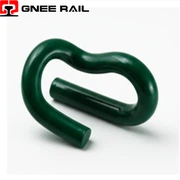
Rail anchors are one-piece spring steel devices that clamp onto the rail base and lodge against the sleeper, transferring the longitudinal forces into the ballast and preventing the creeping of the rail caused by changing temperature, gradients, traffic patterns and braking action of trains. Anchors provide a large bearing surface against the rail base and the tie, preventing cutting and wear and prolonging the working life of the ties. Anchors are made for a specific rail weight and base width and are classified into two types: drive-on rail anchors and spring-type rail anchors.
| Item | Specification |
|---|---|
| Applicable rails | 50 kg, 85 kg, 90/91 lb, 115RE / 136RE, UIC 54 and UIC 60, or other types per customer drawings |
| Materials | 60Si2MnA, 45#, QT500-7 |
| Surface | Plain (oiled), color painting, zinc painted or hot-dip galvanized |
| Reference standards | AS 1085.10-2002, DIN, ISO 9001 |
Chemical composition of anchor materials
| Element (%) | 60Si2MnA | 45# | QT500-7 |
|---|---|---|---|
| C | 0.56-0.64 | 0.42-0.50 | 3.60-3.80 |
| Mn | 0.60-0.90 | 0.50-0.80 | 0.60 max |
| Si | 1.60-2.00 | 0.17-0.37 | 2.50-2.90 |
| Cr | 0.35 max | 0.25 max | - |
| P | 0.03 max | 0.035 max | 0.08 max |
| S | 0.03 max | 0.035 max | 0.025 max |
Ballast and packing
Ample, well-packed ballast provides resistance and stops the anchors from moving. Tamping restores the ballast support around the sleepers.
Sleeper density and type
More sleepers per rail length distribute the longitudinal forces better; steel sleepers grip the rail more firmly than wooden sleepers and reduce creep.
Fastener maintenance
Keeping fasteners tight maintains the clamping force between the rail and the sleeper, preventing the rail from sliding.
Remedial action
For existing creep, the rail is physically pulled back to its correct position and additional anchors are installed, followed by tamping and alignment correction.
FAQ
What is rail creep?
Rail creep is the slow longitudinal movement of the rail in the direction of traffic, caused by braking, acceleration, temperature change and wheel impacts.
Why is rail creep dangerous?
It closes rail gaps at one end, opens them at the other, strains fishplate bolts and sleepers, and can lead to track buckling in hot weather.
How do rail anchors stop creep?
Anchors clamp onto the rail base and bear against the sleeper, transferring the longitudinal forces into the ballast so the rail cannot slide.
What are the main types of rail anchors?
Drive-on rail anchors and spring-type rail anchors; both are made of spring steel in a one-piece construction.
Which materials are used for rail anchors?
Spring steel 60Si2MnA for elastic clamping, 45# medium carbon steel, and ductile iron QT500-7 for heavy-duty applications.
What standard applies to rail anchors in Australia?
AS 1085.10-2002 covers rail anchors in the Australian rail system.