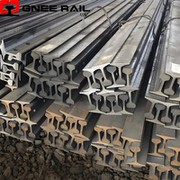
What material is rail made of?
Jan 14, 2026
What material is rail made of?
Rail steel is a high-strength carbon or alloy steel specifically engineered to withstand the extreme pressures and wear caused by repeated train wheel contact. The material must combine high tensile strength, hardness, toughness and fatigue resistance, while remaining weldable and workable for manufacturing. The composition and treatment of rail steel are carefully controlled so the rail can endure heavy axle loads, constant impact and variable environmental conditions such as temperature change and corrosion.
The majority of modern rails, including GB, JIS and UIC rails, are made from high-carbon steel with controlled manganese content, sometimes alloyed with small amounts of vanadium or chromium to enhance wear resistance and reduce brittleness. For specialized applications such as crane rails or high-speed tracks, heat treatment such as normalization or head hardening is applied to raise surface hardness while keeping a resilient core.
Common GB rail steel grades and compositions
| Grade | C (%) | Si | Mn | Cr | V | P | S | Tensile (MPa) |
|---|---|---|---|---|---|---|---|---|
| U71Mn | 0.65-0.76 | 0.15-0.58 | 0.70-1.40 | - | - | 0.035 max | 0.030 max | 880 min |
| U75V | 0.71-0.80 | 0.50-0.80 | 0.75-1.05 | - | 0.04-0.12 | 0.035 max | 0.030 max | 980 min |
| U78CrV | 0.72-0.82 | 0.50-0.80 | 0.70-1.05 | 0.30-0.50 | 0.04-0.12 | 0.035 max | 0.030 max | 1080 min |
| U77MnCr | 0.72-0.82 | 0.10-0.50 | 0.80-1.10 | 0.25-0.40 | - | 0.035 max | 0.025 max | 980 min |
| U76CrRE | 0.71-0.81 | 0.50-0.80 | 0.80-1.10 | 0.25-0.35 | 0.04-0.08 | 0.035 max | 0.025 max | 1080 min |
Structural and light rail steels
Q235B is a low-carbon structural steel used for light rail sections: yield strength 235 MPa minimum, tensile strength 375-460 MPa, elongation 26 percent minimum, with carbon 0.12-0.22 percent. 55Q is a higher-strength light rail steel with a yield strength of 685 MPa minimum and a hardness of about 197 HBW.
Types of steel rails
Light rails
Light rails such as GB 22 kg or 30 kg sections are used for industrial tracks, mining operations, temporary lines and low-traffic railways. They are lightweight, easy to handle and flexible for tight-radius curves and frequently adjusted layouts.
| Section | Height (mm) | Head (mm) | Base (mm) | Web (mm) | Mass (kg/m) |
|---|---|---|---|---|---|
| 8 kg/m | 65 | 25 | 54 | 7 | 8.42 |
| 12 kg/m | 69.85 | 38.1 | 69.85 | 7.54 | 12.2 |
| 15 kg/m | 79.37 | 42.86 | 79.37 | 8.33 | 15.2 |
| 22 kg/m | 93.66 | 50.8 | 93.66 | 10.72 | 22.3 |
| 30 kg/m | 107.95 | 60.33 | 107.95 | 12.3 | 30.1 |
Heavy rails
Heavy rails such as 43 kg, 50 kg or UIC 60 sections are used on mainline, high-speed and heavy-duty industrial tracks. They provide high load-bearing capacity, excellent wear resistance and long service life under frequent, high-intensity traffic.
| Section | Height (mm) | Head (mm) | Base (mm) | Web (mm) | Mass (kg/m) |
|---|---|---|---|---|---|
| 38 kg/m | 134 | 68 | 114 | 13 | 38.733 |
| 43 kg/m | 140 | 70 | 114 | 14.5 | 44.653 |
| 50 kg/m | 152 | 70 | 132 | 15.5 | 51.514 |
| 60 kg/m | 176 | 73 | 150 | 16.5 | 60.64 |
Crane rails
Crane rails are designed for overhead crane and gantry applications with high point loads, normally rolled in U71Mn with a hardened head.
| Section | Height (mm) | Head (mm) | Base (mm) | Web (mm) | Mass (kg/m) |
|---|---|---|---|---|---|
| QU70 | 120 | 70 | 120 | 28 | 52.8 |
| QU80 | 130 | 80 | 130 | 32 | 63.69 |
| QU100 | 150 | 100 | 150 | 38 | 88.96 |
| QU120 | 170 | 120 | 170 | 44 | 118.1 |
FAQ
Why is carbon steel used for rails instead of pure iron?
Carbon and alloy steels provide the tensile strength, hardness and fatigue resistance that pure iron lacks, allowing rails to support heavy axle loads without bending or cracking.
What is the tensile strength of U71Mn rail steel?
U71Mn has a minimum tensile strength of 880 MPa, with a hardness of roughly 240-270 HB.
What is the strongest grade in the list?
U78CrV and U76CrRE both offer a minimum tensile strength of 1080 MPa, suitable for high-speed and very heavy-haul service.
What material is used for light rails?
Q235B and 55Q are typical for GB light rail sections up to 30 kg/m, with 55Q providing higher strength for mining tracks.
Are crane rails made of the same steel as mainline rails?
Crane rails are normally rolled in U71Mn like mainline rails, but the section is flat-bottomed with a wider head and web to carry concentrated wheel loads from crane trolleys.