What Metal Is Commonly Used for Train Rails?
Jan 19, 2026
The Material of Train Rails
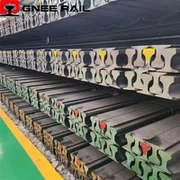
Steel rails, the essential components of railway tracks, are primarily made from high-strength carbon-manganese steel. This material is chosen for its excellent combination of hardness, wear resistance and toughness, allowing rails to withstand the enormous pressure and dynamic loads from trains. The steel rail guides the train forward, bears the enormous pressure and conveys the pressure to the railway sleepers, while providing a smooth and low-resistance surface for the vehicles.
Common Steel Grades
Typical grades include U71Mn, U75V, 55Q, Q235 and R350HT, which are widely used in industrial, mining and mainline railway applications. U71Mn, with carbon 0.65 to 0.76 percent, manganese 1.10 to 1.40 percent and silicon 0.15 to 0.35 percent, is used for mainline heavy rail and high-speed rail. U75V is used for high-speed and heavy-duty applications, 55Q for light rail and industrial lines, Q235 for mining and light industrial lines, and R350HT for high-speed European mainlines.
Why Steel Is Used
Steel is used over other metals such as iron or aluminum because it provides a perfect balance of strength, durability and resistance to wear and fatigue. Unlike pure iron, steel rails can endure repeated dynamic loads from high-speed or heavy freight trains without deforming. Carbon-manganese steels like U71Mn are heat-treated to further improve hardness, allowing longer service life and minimal maintenance. Steel's uniform properties ensure smooth rolling surfaces, which reduces wheel wear and improves safety.
How Steel Rails Are Produced
Rails are manufactured through hot-rolling processes, where carbon-manganese steel is heated and shaped into an I-shaped cross section, consisting of the rail head, web and foot. This design ensures maximum bending resistance and load distribution. Some rails undergo heat treatment to enhance wear resistance, especially for high-speed or heavy-duty tracks. The rails are produced to various international standards including GB, UIC, JIS, AREMA and DIN.
Standards and Rail Types
The rails are produced in standard types such as the GB 22 kg light rail, the UIC60 heavy rail, the JIS 22 kg rail, the AREMA 60RE rail and the DIN A100 crane rail, in lengths from 6 to 25 meters. Standard rail, head-hardened rail, heavy rail, light rail and crane rail are all available, and the type is selected by the line and the load.
Frequently Asked Questions
What metal is used for train rails? High-strength carbon-manganese steel.
What are the common rail steel grades? U71Mn, U75V, 55Q, Q235 and R350HT.
Why is steel preferred over iron? It endures repeated dynamic loads without deforming.
How are rails produced? By hot rolling into an I-shaped section, with optional heat treatment.
What standards are available? GB, UIC, JIS, AREMA and DIN.