What's the difference between a train and a rail?
Jan 21, 2026
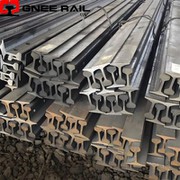
Steel rail, also called railroad rail, crane rail, or railway track, is the primary structural component of a track system. It guides the wheels of trains, cranes, or industrial vehicles while distributing heavy loads onto sleepers or supporting structures. Designed with an I-beam cross-section consisting of a head, web, and base, steel rails provide bending resistance, load-bearing strength, and long-term stability. GNEE RAIL supplies a full range of steel rails, including heavy rails, light rails, crane rails, and flat bar rails, manufactured to meet international standards such as UIC, EN, DIN, AREMA, JIS, and GB.
What's the difference between a train and a rail?
A common misconception is to confuse "train" with "rail," but these two terms refer to completely different components in the railway system.
- Rail (Steel Rail): A steel rail is the track or path on which a train travels. It is a fixed, stationary element of the infrastructure, engineered to guide wheels, withstand high pressures, and maintain alignment under dynamic loads. Rails can be heavy, light, or specialized (like crane rails), depending on their application. GNEE RAIL produces rails of various standards, including QU70-QU120 crane rails, heavy rails like 60kg/m or 75kg/m, and UIC60 railway rails.

As a professional rail fastener supplier, GNEE RAIL can provide different standard steel rail such as GB,American, BS, UIC, DIN, JIS, Australian and South Africa which used in railway lines, cranes and coal mining.
GB Standard Steel Rail
| Classification | Height(mm) | Head (mm) | Bottom (mm) | Thick(mm) | Weight (kg/m) | |
| Light Rail | 8 KG/M | 65 | 25 | 54 | 7 | 8.42 |
| 9 KG/M | 63.5 | 32.1 | 63.5 | 5.9 | 8.94 | |
| 12 KG/M | 69.85 | 38.1 | 69.85 | 7.54 | 12.2 | |
| 15 KG/M | 79.37 | 42.86 | 79.37 | 8.33 | 15.2 | |
| 18 KG/M | 80 | 40 | 80 | 10 | 18.06 | |
| 22 KG/M | 93.66 | 50.8 | 93.66 | 10.72 | 22.3 | |
| 24 KG/M | 107 | 51 | 90 | 10.9 | 24.46 | |
| 30 KG/M | 107.95 | 60.33 | 107.95 | 12.3 | 30.1 | |
| Heavy Rail | 38 KG/M | 134 | 68 | 114 | 13 | 38.733 |
| 43 KG/M | 140 | 70 | 114 | 14.5 | 44.653 | |
| 45 KG/M | 145 | 67 | 126 | 14.5 | 45.546 | |
| 50 KG/M | 152 | 70 | 132 | 15.5 | 51.514 | |
| 60 KG/M | 176 | 73 | 150 | 16.5 | 60.64 | |
| Crane Rail | QU 70 | 120 | 70 | 120 | 28 | 52.8 |
| QU 80 | 130 | 80 | 130 | 32 | 63.69 | |
| QU 100 | 150 | 100 | 150 | 38 | 88.96 | |
| QU 120 | 170 | 120 | 170 | 44 | 118.1 | |
DIN 13674-1-2003 Standard Steel Rail
| Standard:DIN 536 | ||||||
|---|---|---|---|---|---|---|
| Size | Dimension(mm) | Weight (kg/m) |
Length(m) | |||
| Head | Height | Bottom | Thickness | |||
| A55 | 55 | 65 | 150 | 31 | 31.8 | 10-12 |
| A55 | 65 | 75 | 175 | 38 | 43.1 | |
| A75 | 75 | 85 | 200 | 45 | 56.2 | |
| A100 | 100 | 95 | 200 | 60 | 74.3 | |
| A120 | 120 | 105 | 200 | 72 | 100 | |
JIS E 1101 Rail
| Type of Rail | Rail height(mm) | Bottom Width(mm) | Head Width(mm) | Web Thickness(mm) | Steel Grade | Weight(kg/m) |
| A | F | C | t | |||
| 9kg | 63.5 | 63.5 | 32.1 | 5.9 | 55Q/5OMn | 8.94 |
| 10kg | 66.67 | 66.67 | 34.13 | 6.35 | 55Q/5OMn | 10.1 |
| 12kg | 69.85 | 69.85 | 38.1 | 7.54 | 55Q/5OMn | 12.2 |
| 15kg | 79.37 | 79.37 | 42.86 | 8.33 | 55Q/5OMn | 15.2 |
| 22kg | 93.66 | 93.66 | 50.8 | 10.72 | 55Q/5OMn | 22.3 |
| 30kg(30A) | 107.95 | 107.95 | 60.33 | 12.3 | 55Q/5OMn | 30.1 |
| 37kg(37A) | 122.24 | 122.24 | 62.71 | 13.49 | 55Q/5OMn | 37.2 |
| 40kgN(40N) | 140 | 122 | 64 | 14 | 55Q/5OMn | 40.9 |
| 50kg (50PS) | 144.46 | 127 | 67.87 | 14.29 | 55Q/5OMn | 50.4 |
| 50kgN(50N) | 153 | 127 | 65 | 15 | 55Q/5OMn | 50.4 |
| 60kg | 174 | 145 | 65 | 16.5 | 55Q/5OMn | 60.8 |
JIS E 1103 Crane Rail
| Type of Rail | Rail height(mm) | Bottom Width(mm) | Head Width(mm) | Web Thickness(mm) | Steel Grade | Weight(kg/m) |
| A | F | C | t | |||
| CR73 | 135 | 140 | 100 | 32 | U71Mn | 73.3 |
| CR100 | 150 | 155 | 120 | 39 | U71Mn | 100.2 |
American Standard Steel Rail
| ASTM standard, AREMA standard | ||||||
|---|---|---|---|---|---|---|
| Size | Dimension(mm) | Weight (kg/m) |
Length(m) | |||
| Head | Height | Foot | Thickness | |||
| ASCE 25 | 38.1 | 69.85 | 69.85 | 7.54 | 12.4 | 6-12 |
| ASCE 30 | 42.86 | 79.38 | 79.38 | 8.33 | 14.88 | |
| ASCE 40 | 47.62 | 88.9 | 88.9 | 9.92 | 19.84 | |
| ASCE 60 | 60.32 | 107.95 | 107.95 | 12.3 | 29.76 | |
| ASCE 75 | 62.71 | 122.24 | 122.24 | 13.49 | 37.2 | 12-25 |
| ASCE 85 | 65.09 | 131.76 | 131.76 | 14.29 | 42.17 | |
| ASCE 90 | 69.09 | 130.18 | 142.88 | 14.29 | 44.65 | |
| ASCE 115 | 69.06 | 139.7 | 168.28 | 15.88 | 56.9 | |
| ASCE 136 | 74.61 | 152.4 | 185.74 | 17.46 | 67.41 | |
| ASCE 175 | 109.86 | 152.4 | 152.4 | 38.1 | 86.8 | |
- Train: A train is the vehicle that moves along the rails, composed of locomotives and rolling stock (freight cars, passenger cars, or specialized vehicles). The train relies on rails to operate safely and efficiently, while its wheels exert pressure on the rail, requiring the rail to be strong and durable.

- In short, the rail is the foundation, and the train is the moving load that depends on it. Without rails, trains cannot operate; without trains, rails serve only as static structures.
Since 2008, GNEE RAIL has been supplying steel rails of different grades for more than 18 years, steel rails from GNEE is highly recommened in China and abroad.Wtih cutting edge equipment, GNEE produces high quality steel rails that meet with requirements of most countries. Standard rail, head hardened rail, heavy rail,light rail,crane rail and other types are all available here, as one of the China main rail supplier, GNEE RAIL has been working on supplying economical green railway products all over the world.