What is the function of the grooves on QU120 crane rail pad surfaces?
Sep 17, 2026

What is the function of the grooves on QU120 crane rail pad surfaces?
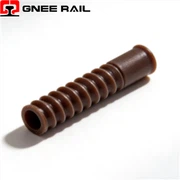
The grooves on QU120 crane rail pad surfaces are engineered to deliver the required load-deflection characteristic for heavy crane track systems. They create low initial stiffness that keeps the pad in intimate contact with the rail base even during vertical rail movements, while building sufficient stiffness under full wheel loads to prevent excessive rail shift that could loosen fastening components. For QU120 crane rail pads, which are designed to match the 168 mm rail base width of QU120 rails, these surface grooves also increase friction between the pad and both the rail foot and supporting structure, reducing slip risk under frequent crane start-stop and turning loads.

Crane rail pads operate in demanding environments characterized by high wheel pressures, frequent load cycles, and occasional horizontal thrusts from crane movement. Unlike standard railway pads that primarily handle vertical passenger or freight loads, QU120 crane rail pads must absorb both vertical impacts and lateral forces generated when overhead cranes, gantry cranes, and similar heavy equipment start, stop, or change direction. The grooved surface design complements the pad's core elastomer material properties, which typically include wear-resistant synthetic rubber blends with oil and UV resistance to suit workshop, port, and storage yard conditions.
The load-deflection behavior enabled by the grooves directly supports the pad's soft mounting function. When a crane wheel passes over a supported section, the grooves compress incrementally to distribute the wheel load over a larger contact area, eliminating localized stress concentration that could damage the rail base or concrete/steel support structure. This controlled deformation also compensates for minor unevenness in the supporting foundation, ensuring consistent contact between the rail and pad across the full runway length. For QU120 applications, which often involve heavy lifting capacities and long crane spans, this load distribution capability reduces fatigue damage to both the rail and the runway structure over time.

Beyond load management, the grooves contribute to noise and wear reduction in crane track systems. They dampen metal-to-metal friction noise between the rail base and pad surface, lowering operational noise levels in indoor workshops and enclosed port facilities. The grooves can also trap small amounts of dust and debris that would otherwise cause abrasive wear between contact surfaces, extending the service life of both the pad and the rail. In oil-exposed workshop environments, the grooved texture helps maintain stable friction performance even when minor amounts of grease or lubricant come into contact with the pad surface.
Click here to get a quote for the QU120 crane rail pad.
GNEE RAILWAY supplies QU120 crane rail pads with customizable groove patterns and pad thicknesses ranging from 5 mm to 20 mm, adjusted to match specific wheel load requirements for each project. Every pad undergoes strict compression performance and hardness testing to ensure consistent elastic behavior and long-term durability under heavy cyclic loads. Mill Test Certificates are provided with every shipment to verify material properties and dimensional accuracy.
FAQ
Q: What materials are used for grooved QU120 crane rail pads?
A: Grooved QU120 crane rail pads are primarily made from wear-resistant synthetic rubber blends, often combining natural rubber for elasticity, NBR for oil resistance, and carbon black for reinforcement. Optional materials include SBR for cost-effective wear performance and EVA for lightweight impact absorption, with PU composite rubber available for applications requiring superior abrasion resistance.
Q: How thick are QU120 crane rail pads with surface grooves?
A: Standard grooved QU120 crane rail pads have thicknesses ranging from 5 mm to 20 mm, with the exact thickness selected based on the crane's wheel load and runway design. Thicker pads provide more cushioning and vibration damping, while thinner pads maintain a lower track profile for applications with limited vertical clearance.
Q: Do grooved QU120 crane rail pads work for both continuous and discontinuous mounting?
A: Yes, grooved QU120 crane rail pads are available for both continuously supported rail systems and discontinuous mounting setups. The groove design maintains consistent load distribution and friction performance regardless of the mounting type, as long as the pad dimensions and thickness are matched to the specific support configuration.
Q: What benefits do grooved pads offer compared to flat crane rail pads?
A: Grooved crane rail pads provide a more controlled load-deflection characteristic, with low initial stiffness for secure rail contact and sufficient working stiffness to prevent excessive rail movement. They also offer better anti-slip performance, improved noise reduction, and enhanced debris tolerance compared to flat pads, making them well-suited for heavy crane track applications with frequent start-stop cycles.