How thick should a QU120 crane rail pad be?
Sep 17, 2026

How thick should a QU120 crane rail pad be?
The standard thickness range for QU120 crane rail pads is 5–20 mm, with the exact value adjusted based on crane wheel load, operating frequency, and foundation type. For most overhead and gantry crane runway applications using QU120 rails, pads between 10 mm and 16 mm deliver the optimal balance of load distribution, vibration damping, and track stability. Pads at the lower end of the range suit light-duty cranes with lower wheel pressures, while thicker options are specified for heavy-duty, high-cycle crane systems.
-
Core Functions of QU120 Crane Rail Pads
QU120 crane rail pads serve as resilient intermediate layers installed between the QU120 crane rail foot and the supporting concrete or steel foundation. Their primary role is to distribute concentrated wheel loads across a larger contact surface, eliminating localized stress points that can cause fatigue damage to both the rail and the supporting structure. During crane start-up, braking, and turning operations, the pads absorb vertical impact forces and horizontal thrusts, reducing structural vibration and extending the service life of rail components and crane mechanisms.

These elastic rail pads also compensate for minor unevenness in the runway foundation, ensuring consistent, intimate contact between the rail base and the support surface. This conformity prevents rail rocking and reduces metal-to-metal friction noise, creating a quieter working environment for port, workshop, and storage yard operations. The pads also act as a protective barrier, minimizing direct abrasive wear between the steel rail and the underlying concrete beam or steel girder.
-
Material Options for QU120 Crane Rail Pads
QU120 crane rail pads are commonly manufactured from synthetic rubber blends, primarily natural rubber combined with NBR for enhanced oil resistance, carbon black for reinforcement, and vulcanizing agents for improved structural integrity. This material formulation delivers excellent wear resistance, compressive strength, antioxidant performance, and UV stability, making it suitable for both indoor and partially outdoor crane runway environments with oil, dust, and temperature fluctuations.
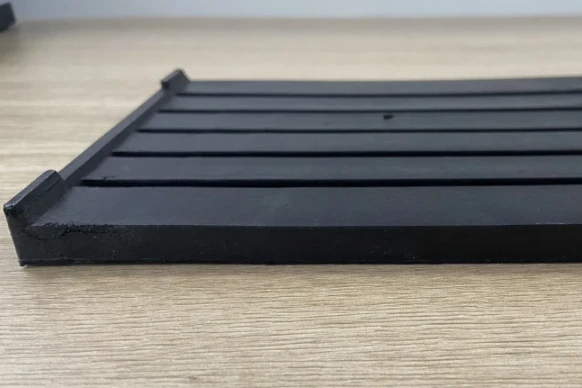
For applications requiring lighter weight and high impact absorption, EVA and HDPE rail pad options are also available. EVA pads offer high flexibility and elongation properties, while HDPE pads provide higher hardness and excellent electrical insulation performance. For long-span, heavy-load crane systems, multi-layer composite pads with embedded steel plates or steel mesh cores are used to boost rigidity and load-bearing capacity while maintaining elastic cushioning performance.
| Mechanical properties of the Rubber Rail Pad | ||
| Technical Parameter | Unit | Value |
| Stiffness | KN | 90-130 |
| Hardness Shore A | ℃ | 72-80 degree |
| Electronic Resistance | Ω | ≥ 106 |
| Tensile Strength before Aging | Mpa | ≥12.5 |
| Elongation before Aging | % | ≥250 |
| Mechanical properties of EVA Rail Pad | |||
| Technical Parameter | Unit | Technical Requirement | Value |
| Density | g/cm3 | 0.95-0.98 | 0.95 |
| Tensile Strength | Mpa | ≥15 | 16 |
| Elongation | % | >500 | 550 |
| Melting Point | ℃ | 170-190 | 170 |
| Insulation Resistance | Ω | ≥1×10¹⁰ | 5.0 ×10¹⁰ |
| Hardness | A | ≥90 | 92(A) |
| Mechanical properties of HDPE Rail Pad | |||
| Technical Parameter | Unit | Technical Requirement | Value |
| Density | g/cm3 | 0.95-0.98 | 0.95 |
| Tensile Strength | Mpa | ≥19 | 19 |
| Elongation | % | >80 | 150 |
| Melting Point | ℃ | 170-190 | 190 |
| Insulation Resistance | Ω | ≥1×10¹⁰ | 3.5 ×10¹⁰ |
| Hardness | A | ≥98 | 98(A) |
Thickness Selection Guidelines for QU120 Crane Rail Pads
Selecting the appropriate QU120 crane rail pad thickness depends on three key factors: wheel load, operating duty cycle, and foundation type.
For light-duty cranes with wheel loads under 20 tons operating at low frequency, 5–8 mm thick pads provide sufficient cushioning while maintaining a low track profile. For medium-duty workshop cranes with wheel loads between 20 and 50 tons, 10–12 mm thick rubber pads are the standard specification, offering reliable vibration damping and load distribution without excessive track height increase.
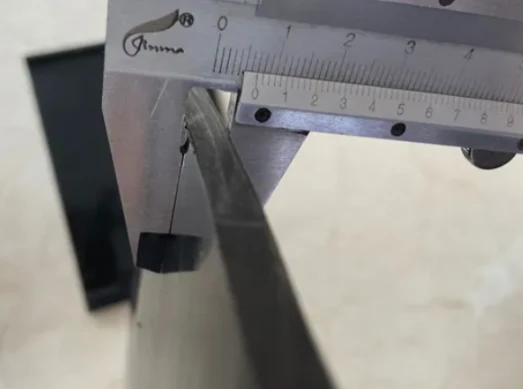
For heavy-duty port gantry cranes and high-cycle overhead cranes with wheel loads exceeding 50 tons, 15–20 mm thick pads are recommended. These thicker pads deliver enhanced shock absorption and reduce fatigue stress on the runway structure, though they do raise the overall track height slightly, so clearance and crane end truck dimensions must be verified during design. For QU120 rail applications, the PA7-168 pad model with a 168 mm width is specifically matched to the QU120 rail base dimensions, available across the full 5–20 mm thickness range.
All QU120 crane rail pads supplied by GNEE RAILWAY undergo strict quality control, including compression performance testing, elasticity verification, and hardness measurement to ensure consistent performance under specified load conditions. Mill Test Certificates are provided with every shipment to confirm material properties and dimensional accuracy, and third-party inspection can be arranged at any stage upon request.
GNEE RAILWAY supplies not only QU120 crane rail pads but also a full range of matching crane track components, including rails, rail clips, joint bars, and bolt fasteners, all engineered for perfect compatibility. This one-stop procurement approach eliminates component mismatch risks and simplifies project sourcing for crane runway construction and maintenance.
FAQ
- What is the standard thickness range for QU120 crane rail pads?
The standard thickness range for QU120 crane rail pads is 5–20 mm, with the exact thickness selected based on crane wheel load, operating frequency, and foundation type. Medium-duty applications typically use 10–12 mm pads, while heavy-duty high-cycle cranes require 15–20 mm thick pads for enhanced shock absorption.
- What materials are QU120 crane rail pads made of?
QU120 crane rail pads are most commonly made from synthetic rubber blends, primarily natural rubber combined with NBR for oil resistance, carbon black for reinforcement, and vulcanizing agents for improved durability. Optional materials include EVA for lightweight impact absorption, HDPE for high hardness and insulation, and multi-layer composite structures with steel cores for heavy-load applications.
- How do I choose the right thickness for my QU120 crane rail pad?
Start by calculating your crane's maximum wheel load and evaluating its operating duty cycle. Light-duty, low-frequency cranes with wheel loads under 20 tons work well with 5–8 mm pads, medium-duty 20–50 ton cranes use 10–12 mm pads, and heavy-duty cranes over 50 tons require 15–20 mm pads. Always verify track clearance limits before selecting thicker pad options.
- What pad width is compatible with QU120 crane rails?
The PA7-168 crane rail pad, with a width of 168 mm, is specifically designed to match the base dimensions of QU120 crane rails. This width ensures full coverage of the rail foot for uniform load distribution across the pad surface.
- Can QU120 crane rail pads be customized?
Yes, QU120 crane rail pads can be fully customized in terms of thickness, hardness, surface texture, mounting hole patterns, and overall dimensions to fit specific project requirements. Both continuous and discontinuous pad configurations are available, with optional grooved or diamond-patterned surfaces for enhanced anti-slip performance.