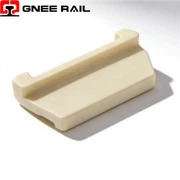
How do Rail Rubber Pads work together with other Rail Fastenings?
Nov 25, 2025
How do Rail Rubber Pads work together with other Rail Fastenings?
Rail rubber pads work with other rail fasteners to form an integrated system that holds the rail to the sleeper while absorbing impact and reducing vibration. The pads sit between the rail and the tie plate or sleeper, using their elasticity to cushion the force of passing trains, while clips, bolts, and spikes hold the components together firmly. This combination protects the track components from wear and abrasion, improves passenger comfort, and enhances overall track stability and lifespan.

How the components work together
- Load distribution: The rubber pad distributes the impact load from the wheels over a larger surface area, reducing pressure on the tie plate and sleeper.
- Shock absorption: The pad's elasticity acts as a buffer, absorbing and damping the vibrations from the train to provide a smoother, quieter ride.
- Component protection: By absorbing shock and vibration, the pad prevents direct impact between the rail and the tie, which protects both from abrasion, crushing, and premature wear.
- Securing the rail: While the pad provides elasticity, other fasteners like spring clips, rail bolts, and screw spikes are used to firmly clamp the rail and tie plate to the sleeper or concrete slab.
- Maintaining system integrity: The system is designed so that the stiffness of the rail pad allows for some deformation under load, ensuring the fasteners can maintain close contact with the rail despite vertical movement.

| Rubber Rail Pad | ||
| Technical Parameter | Unit | Value |
| Stiffness | KN | 90-130 |
| Hardness Shore A | ℃ | 72-80 degree |
| Electronic Resistance | Ω | ≥ 106 |
| Tensile Strength before Aging | Mpa | ≥12.5 |
| Elongation before Aging | % | ≥250 |
Characteristics of Railway Track Padding
1. Strong shock absorption, anti-aging properties, wear resistance, stability, and resistance to high and low temperatures. Products combine natural rubber, styrene-butadiene rubber, neoprene, HDPE, EVA, and high-density polyethylene. They exhibit high elasticity and resist deformation or fracture across various temperatures.
2. Extended service life with low maintenance and replacement costs.

3. Comprehensive range of models suitable for laying various rails (43kg, 50kg, 60kg) and sleepers (wooden, concrete).
4. Excellent load-bearing capacity, vibration damping, and insulation properties. Highly wear-resistant with minimal compression deformation, superior rigidity, aging resistance, and no mud displacement. Long service life and easy installation. Railway rubber pads significantly enhance rolling stock transport capacity, reduce crossing maintenance frequency, and prevent traffic accidents caused by stalled vehicles.
As a professional rail fastener manufacturer, GNEE RAILWAY RAILWAY can produce various types of rubber rail pads with different materials, such as natural rubber, EVA, HDPE and so on. Our EVA/HDPE/rubber rail pads are with high elasticity, applying to types for rails such as rail UIC54, UIC60, BS80lbs,BS100lbs, and sizes as ordered. The pads can be customized with or without grooves, in various possible designs, depending on customers' requirements.