How to Install Crane Rails: Step-by-Step Guide for QU70-QU120
Sep 29, 2025
Why Crane Rail Installation Is Demanding
A crane rail carries a crane along a fixed runway and must stay geometrically accurate for the life of the installation. Unlike a railway line, where loads are spread along the rail by many wheels, a crane concentrates large wheel loads on short sections of rail and repeats this loading on every travel cycle. The rail must therefore be laid on a foundation that does not settle, aligned within tight tolerances, and fastened so that it cannot creep or shift. This guide covers the standard sequence used for overhead and gantry crane runways.
Crane Rail Sections at a Glance
Crane rails are heavy sections with a wide base and thick web, designed for concentrated wheel loads. The most common series is the QU family, which is defined by GB/T 3426 and matches DIN 536 practice for crane rails.
| Rail type | Height (mm) | Base width (mm) | Head width (mm) | Web thickness (mm) | Weight (kg/m) |
|---|---|---|---|---|---|
| QU70 | 120 | 120 | 70 | 28 | 52.8 |
| QU80 | 130 | 130 | 80 | 32 | 63.69 |
| QU100 | 150 | 150 | 100 | 38 | 88.96 |
| QU120 | 170 | 170 | 120 | 44 | 118.1 |
Stage 1: Foundation Preparation
The rail is normally laid on a concrete beam, a steel girder, or dedicated sleepers supported by the runway structure. Before any rail is placed, the bearing surface must meet the design requirements for flatness, strength, and load capacity, and must be free of debris, oil, and loose material. On outdoor runways in ports and steel plants, the design must also handle drainage, corrosion protection, and possible foundation settlement. Getting the foundation wrong cannot be corrected later by adjusting the rail, so this stage deserves the most care.
Stage 2: Layout and Alignment
Rail sections are positioned according to the crane span and the design gauge. Precision instruments are used to correct three things: the gauge between the two rails of the runway, the level of each rail, and the longitudinal alignment of the rail against the crane travel line. A common method is to set the rail on temporary packers, adjust the alignment, then fix it permanently. The accepted tolerances depend on the crane class and speed, but the principle is the same everywhere: the rail line must match the wheel path, not the other way round.
Stage 3: Fixing and Anchoring
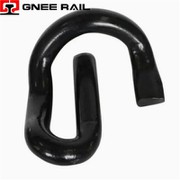
The rail is fastened to the foundation with a system of rail pads, crane rail clips, and high-strength bolts, or with continuous welded fastening on steel girders. Each clip and bolt must be tightened to the torque specified in the design; uneven tightening is a frequent cause of later rail creep and clip failure. Where rails meet, fishplates or welded joints are used, and a small expansion gap must be left at the ends of each rail section to allow for thermal expansion and contraction. On long runways the expansion gap positions should follow the design, never be improvised on site.
Stage 4: Commissioning and Inspection
After installation, a full-line inspection is required before the crane returns to service. The checks cover gauge, alignment, longitudinal level, joint alignment, and the condition of every fastening. It is also normal to retighten fastenings after the first days of operation, when initial settlement has occurred, and then to inspect the runway at regular intervals. Rail wear, fishplate bolts, and clip toe loads should be checked on a maintenance schedule matched to the crane duty.
Common Mistakes to Avoid
Laying rails on an unlevel foundation and trying to compensate with packers after the event.
Overtightening or undertightening clips and bolts, causing rail creep or clip breakage.
Omitting expansion gaps or placing them where the crane wheel passes over the joint.
Using standard railway rails instead of crane rails on high-duty runways, leading to rapid head wear and rail deformation.
Skipping the post-commissioning retightening pass.
Frequently Asked Questions
1. Can standard railway rails be used for crane runways?
Only on light-duty runways. Crane rails have a wider base and thicker web to handle concentrated wheel loads and repeated braking. Standard rails deform faster under crane traffic and increase the risk of rail and wheel damage.
2. What is the correct expansion gap for crane rails?
The gap is calculated from the rail length, the expected temperature range, and the coefficient of thermal expansion of steel. It is set in the track design; on site it must be checked against the ambient temperature at the time of installation.
3. Should crane rail joints be welded or fishplated?
Both are used. Welded joints give a continuous running surface and are preferred on high-speed, high-duty runways. Fishplated joints are easier to maintain and adjust, and are common on standard-duty runways. The choice is part of the track design.
4. How often should crane rail fastenings be retightened?
Fastenings should be retightened shortly after commissioning, then inspected at regular intervals defined by the maintenance plan. Runways under heavy duty, such as in ports and steel plants, need more frequent inspection than light workshop cranes.
5. What causes crane rail creep?
Rail creep is longitudinal movement caused by wheel friction and braking forces. It is controlled by proper clamping force, rail anchors or clips, and correct expansion gap placement. Persistent creep usually points to undertightened fastenings or an anchor layout that does not match the drive arrangement of the crane.
6. Which rail section should I choose for my crane?
Selection depends on wheel load, wheel spacing, crane duty class, and runway length. QU70 suits light and medium cranes, while QU80 to QU120 are used as crane capacity and duty increase. The crane manufacturer's wheel load data is the starting point for the rail section calculation.