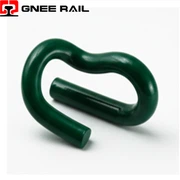
What are the different types of C railway clips?
Dec 29, 2025
Rail clip, also called elastic rail clip, it is used to fasten the rail tracks with railroad spike, rail pad, track bolt, rail joint bar together. It is also usually used as a part of rail fastening system. There are huge demand of rail clips on the railway line, about 7000pcs per kilometer, which is directly related to rail safety.

What are the different types of C railway clips?
C railway clips, often called Elastic Rail Clips (ERCs) or Tension Clips, come in several main types like SKL series, E-type, PR clips, and specialized Nabla clips, designed for different rail profiles and fastening needs, providing elasticity and strong grip on concrete or wooden sleepers, with SKL (e.g., SKL1, SKL3, SKL12, SKL14) being very common globally for high-speed lines.
Here are some common C-type rail clip series:
- SKL Clips: A very popular series, known for high elasticity, includes types like SKL1, SKL3, SKL12, SKL14, and SKL75, widely used with concrete sleepers.

| SKL Rail clip specification | |
| Name | SKL tension clamp |
| Material | 60Si2MnA 60Si2CrA 55Si2Mn 38Si7 |
| Hardness | 42-47HRC |
| Fatigue Life | for Dia.18 is 3 millions cycles without breaking |
| for Dia.20 is 5 millions cycles without breaking | |
| Surface | plain (oiled), Oxide black, color painting or according to customer requirement |
| Standard | DIN17221, BS970, GB/T1222 |
- E-Type Clips: Another common elastic design, often seen as E2055, providing significant clamping force.

| Model | Diameter | Material | Under Pressure | HRC | Weight |
| E1609 | Ø 16mm | 60Si2MnA | ≥950kg | 44-48 | 0.43kg/pc |
| E1809 | Ø 20mm | 60Si2MnA | ≥950kg | 44-48 | 0.61kg/pc |
| E1813 | Ø 18mm | 60Si2MnA | ≥950kg | 44-48 | 0.62kg/pc |
| E2001 | Ø 20mm | 60Si2MnA | ≥950kg | 44-48 | 0.80kg/pc |
| E2009 | Ø 20mm | 60Si2MnA | ≥950kg | 44-48 | 0.80kg/pc |
| E2039 | Ø 20mm | 60Si2MnA | ≥950kg | 44-48 | 0.80kg/pc |
| E2007 | Ø 20mm | 60Si2MnA | ≥950kg | 44-48 | 0.80kg/pc |
| E2055 | Ø 20mm | 60Si2MnA | ≥950kg | 44-48 | 0.80kg/pc |
| E2056 | Ø 20mm | 60Si2MnA | ≥950kg | 44-48 | 0.80kg/pc |
| E2063 | Ø 20mm | 60Si2MnA | ≥950kg | 44-48 | 0.80kg/pc |
- PR Clips: Such as the PR309, offering strong fastening and good load dispersion.
- Nabla Clips: A specific type of elastic clip known for its unique shape that engages the rail base effectively.
- Pandrol Clips: A brand name often used generically for ERCs, especially in India, referring to various designs that offer resilience.
What is the function of an elastic rail clip?
An elastic rail clip's primary function is to securely fasten steel rails to railway sleepers (ties), preventing unwanted vertical and horizontal rail movement, thus maintaining correct track gauge and ensuring train safety. These forged spring steel clips provide consistent clamping force, absorb shock and vibration, and withstand repeated bending, torsion, and impact loads, ensuring track integrity and stability over time.
Key Functions:
- Secure Fastening: Creates a strong, reliable connection between the rail and sleeper.
- Gauge Maintenance: Prevents the rail from shifting sideways, keeping the correct distance (gauge) between rails for safe passage of wheels.

- Vibration & Shock Absorption: The elastic nature of the clip absorbs energy from passing trains, reducing impact on the track structure.
- Resilience: Designed to endure constant stress from train loads, fatigue, bending, and torsion, requiring high-grade spring steel for durability.
- Track Integrity: Maintains the overall stability and alignment of the track, crucial for preventing derailments.
GNEE RAIL offer an extensive range of rail clips with optimum quality, these rail clips are designed with high precision and made up of premium grade spring steel. GNEE has been the largest and most competitive production base of rail clip in China after more than 18 years' rail clip producing experience, and have qualification to tender nationally large and medium scaled rail projects. What's more, our rail clip can be customized according to clients' requirements.