


What Are the Height and Weight of 115RE Rail?
Jun 15, 2026

115RE rail is one of the most widely used heavy-duty rail sections specified by AREMA (American Railway Engineering and Maintenance-of-Way Association). Known internationally as the TR57 rail profile, 115RE rail weighs 115 lb/yd (approximately 56.9 kg/m) and is designed for freight railways, industrial tracks, mining railways, ports, and heavy-haul transportation systems. Its balanced geometry provides good load distribution, wear resistance, and long-term track stability, making it a widely used rail profile throughout North America and other regions using American railway standards.
115RE indicates an AREMA standard rail profile weighing 115 pounds per yard. The "RE" designation identifies the standardized railway engineering rail section used throughout North America.
How much does 115RE rail weigh per meter?
115RE rail weighs approximately 56.9 kilograms per meter, equivalent to 115 pounds per yard.
What is the height of 115RE rail?
The standard height of a 115RE rail section is 168.3 mm (6.625 inches).
Is 115RE rail the same as TR57 rail?
Yes. TR57 is the international designation commonly used for the same rail profile. Both refer to the AREMA 115RE rail section with a nominal weight of 56.9 kg/m.
What standard governs 115RE rail dimensions?
115RE rail dimensions are specified by AREMA, the American Railway Engineering and Maintenance-of-Way Association, which publishes the recognized standards for railway track components used throughout North America.
What length is available for 115RE rails?
Standard supply lengths typically range from 12 m to 25 m, while longer welded rail sections can be produced according to project requirements.
115RE Rail Height and Weight
The most frequently requested technical information about the115RE rail profileis its height and weight. According to the AREMA rail section standard, the nominal weight of 115RE rail is 115 lb/yd, equivalent to approximately 56.9 kg/m. The rail section height is 168.3 mm, providing sufficient structural stiffness for medium- to heavy-duty railway operations.
Because rail weight directly influences load-carrying capacity, fatigue resistance, and service life, the 115RE section is commonly selected for heavy freight routes, industrial rail systems, mining railways, and port handling facilities.
115RE Dimensions
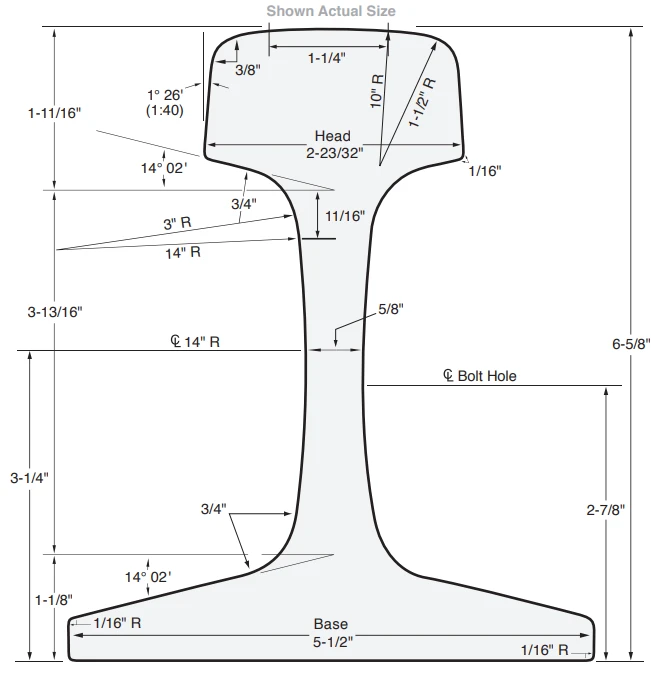
| Parameter | 115RE Rail Value |
|---|---|
| Rail Profile | 115RE (TR57) |
| Standard | AREMA |
| Nominal Weight | 115 lb/yd |
| Weight per Meter | 56.9 kg/m |
| Rail Height | 168.3 mm |
| Head Width | 69.1 mm |
| Base Width | 139.7 mm |
| Web Thickness | 15.9 mm |
| Cross-sectional Area | 72.58 cm² |
At GNEE RAIL, strict quality control procedures ensure that every 115RE (115 lb/yd) rail we supply fully complies with AREMA dimensional and material requirements. From raw material selection and steelmaking to rolling, straightening, and final inspection, each production stage is monitored to guarantee accurate rail height, weight, profile geometry, and mechanical properties. Every 115RE rail undergoes dimensional verification using calibrated measuring equipment to confirm the standard height of 168.3 mm and the nominal weight of 56.9 kg/m.
In addition, chemical composition analysis, ultrasonic testing, hardness testing, and third-party inspections are available to ensure consistent quality and traceability. With extensive experience in supplying AREMA-standard rails to global railway, mining, and industrial projects, GNEE RAIL delivers reliable 115RE rails that meet the performance, safety, and durability requirements of modern track systems.
115RE Rail Profile MTC


If you require further information about115RE rail specifications, tolerances, inspection procedures, or AREMA compliance, the technical team at GNEE RAIL can provide detailed assistance and supporting documentation.
Why Is 115RE Rail Height Important?
Rail height is a critical parameter affecting the bending strength and stiffness of the track structure. The 168.3 mm height of the 115RE rail enables the section to withstand significant vertical loads while maintaining track geometry.
A taller rail profile generally offers:
Higher moment of inertia, resulting in better resistance to bending under train loads.
Improved distribution of wheel forces into sleepers and ballast.
Enhanced fatigue life under repeated heavy-haul traffic.
Greater wear allowance before replacement becomes necessary.
For industrial and freight railways where axle loads are high and operating conditions are demanding, the 168.3 mm profile height provides an effective balance between strength and economic efficiency.
How Does 115RE Rail Weight Affect Railway Performance?
The weight of a rail section directly reflects the amount of steel available to resist wear, fatigue, and structural deformation. At 56.9 kg/m, the 115RE rail belongs to the heavy rail category and offers substantial load-bearing capacity.
Heavier rail sections provide several operational advantages:
Reduced rail deflection under heavy loads.
Lower maintenance requirements.
Improved track stability.
Extended service life.
Better resistance to rail head wear and contact stress.
For mining operations, industrial rail systems, and freight corridors, the 115RE rail profile often represents an optimal combination of performance and cost-effectiveness.
Where Is 115RE Rail Commonly Used?
The 115RE rail profile is widely deployed in railway systems requiring reliable performance under moderate to heavy loading conditions. Typical applications include freight railways, mining transportation networks, steel mills, industrial rail sidings, port terminals, logistics centers, and bulk material handling facilities.

Its combination of high strength, moderate weight, and proven field performance makes it one of the most versatile AREMA rail sections available today.
FAQ About 115RE Rail
What does 115RE mean?
115RE indicates an AREMA standard rail profile weighing 115 pounds per yard. The "RE" designation identifies the standardized railway engineering rail section used throughout North America.
How much does 115RE rail weigh per meter?
115RE rail weighs approximately 56.9 kilograms per meter, equivalent to 115 pounds per yard.
What is the height of 115RE rail?
The standard height of a 115RE rail section is 168.3 mm (6.625 inches).
Is 115RE rail the same as TR57 rail?
Yes. TR57 is the international designation commonly used for the same rail profile. Both refer to the AREMA 115RE rail section with a nominal weight of 56.9 kg/m.
What standard governs 115RE rail dimensions?
115RE rail dimensions are specified by AREMA, the American Railway Engineering and Maintenance-of-Way Association, which publishes the recognized standards for railway track components used throughout North America.
What length is available for 115RE rails?
Standard supply lengths typically range from 12 m to 25 m, while longer welded rail sections can be produced according to project requirements.
What is 115RE rail used for?
115RE rail is primarily used for medium- to heavy-duty railway applications, including regional railroads, class I freight mainlines with moderate traffic, and industrial yard tracks. It is also a standard choice for passenger transit systems, such as commuter rail, subways, and light rail networks.
What is the difference between 115RE and 132RE?
The main differences are weight, dimensions, and load capacity; 132RE is heavier (132 lbs/yd) and taller (7-1/8 inches) than 115RE (115 lbs/yd and 6-5/8 inches tall). Because of its larger profile, 132RE offers greater structural rigidity and is preferred for heavy-haul freight corridors with very high axle loads.
What steel grades are available for 115RE rail?
It is commonly available in standard carbon steel, intermediate strength, and premium high-strength grades, such as head-hardened (HH) or low-alloy steels. These grades conform to AREMA specifications to provide different levels of wear resistance and fatigue life based on traffic demands.
Conclusion
With a height of 168.3 mm and a weight of 56.9 kg/m, the 115RE rail profile remains one of the most widely specified AREMA heavy rail sections for freight transportation, industrial railways, and mining operations. Its geometry, load-bearing capacity, and compatibility with North American railway standards make it a suitable option for long-term railway infrastructure projects. Understanding the precise dimensions and engineering characteristics of 115RE rail is essential when selecting rail sections for new track construction, rail replacement programs, and heavy-haul transportation systems.


