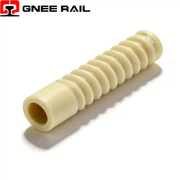
What is an elastic rail clip used for?
Jan 28, 2026
What is an elastic rail clip used for?
An elastic rail clip is a specialized, durable spring-steel fastener used to secure railway rails to sleepers, whether concrete or timber. Its primary purpose is to hold the rail down with a long-lasting elastic clamping force, preventing longitudinal movement, reducing vibration, and keeping the track gauge stable in high-speed, heavy-haul and conventional railway applications. Because the clip is self-tensioning and needs no threads, it is a fit-and-forget component that lowers maintenance cost compared with bolted fasteners that loosen over time.
Main uses of elastic rail clips
Secure rail fixing: fastens the rail to concrete and timber sleepers using a non-threaded, self-tensioning system, so the rail cannot shift, warp or overturn.
Creep prevention: the toe load creates high longitudinal resistance that stops the rail from creeping under braking and traction forces.
Vibration damping: used together with rail pads to absorb noise and vertical impact, protecting the track structure from fatigue damage.
Electrical insulation: when paired with plastic insulators and insulating pads, the assembly prevents current leakage in electrified railways and keeps track circuits reliable.
Gauge maintenance: constant clamping keeps the distance between rails within tolerance, which is essential for safe wheel-rail contact, especially on curves and turnouts.
Versatility: suitable for heavy-haul, high-speed and metro systems, and installable either by hand tools or by mechanised equipment on large projects.
Typical E-type clip parameters
The following table lists common E-type elastic clip models with their bar diameter, material, minimum toe load and hardness as typically specified:
| Model | Diameter | Material | Toe load | Hardness |
|---|---|---|---|---|
| E1609 | Ø 16 mm | 60Si2MnA | ≥950 kgf | 44-48 HRC |
| E1809 | Ø 20 mm | 60Si2MnA | ≥950 kgf | 44-48 HRC |
| E1813 | Ø 18 mm | 60Si2MnA | ≥950 kgf | 44-48 HRC |
| E2001 | Ø 20 mm | 60Si2MnA | ≥950 kgf | 44-48 HRC |
| E2007 | Ø 20 mm | 60Si2MnA | ≥950 kgf | 44-48 HRC |
| E2009 | Ø 20 mm | 60Si2MnA | ≥950 kgf | 44-48 HRC |
| E2039 | Ø 20 mm | 60Si2MnA | ≥950 kgf | 44-48 HRC |
| E2055 | Ø 20 mm | 60Si2MnA | ≥950 kgf | 44-48 HRC |
| E2056 | Ø 20 mm | 60Si2MnA | ≥950 kgf | 44-48 HRC |
| E2063 | Ø 20 mm | 60Si2MnA | ≥950 kgf | 44-48 HRC |
Fast-install clip designs, driven perpendicular to the rail, add installation speed on large contracts; typical designs provide a nominal clamping pressure of 1000 to 1250 kgf, a clamping force above 16 to 20 kN and creep resistance above 7 to 9 kN.
Installation and maintenance practice
On concrete sleepers, the clip is driven into the shoulder cast into the sleeper; on timber sleepers, it engages with a baseplate and shoulder assembly. Extraction for maintenance is performed with a clip remover, and the rail pad and insulator can then be inspected and replaced without damaging the sleeper. This fast exchange capability is particularly valuable on metro and high-speed lines where maintenance windows are short.
FAQ
1. Why does an elastic clip reduce maintenance compared with bolted fasteners?
Bolted fasteners lose preload as vibration and settlement occur, so they need periodic retightening. An elastic clip stores spring energy and automatically maintains its toe load, so it does not need regular retightening over its service life.
2. Can elastic clips be used with wooden sleepers?
Yes. With a suitable baseplate and shoulder, elastic clips fasten the rail to timber sleepers reliably. The assembly spreads the clamping force over the wood and protects it from crushing.
3. How is the toe load of a clip verified?
Toe load is measured on a calibrated test rig by deflecting the clip to the design installation position and reading the force, typically following the procedure in EN 13146-7. Suppliers should provide the test report together with the batch certificate.
4. What happens if the wrong clip model is used for a fastening system?
Clip geometry must match the shoulder and rail foot profile. An incompatible clip may not reach the design toe load, may loosen under traffic, or may over-stress the shoulder. Always select the clip model specified for the fastening system.
5. Do clips need insulators on electrified lines?
Yes. On electrified railways and track-circuited sections, plastic insulators and insulating rail pads prevent current leakage from rail to sleeper and keep the signalling circuit isolated. The assembly insulation resistance is typically specified above 5 kΩ.
6. What is the typical service life of an elastic clip?
With correct heat treatment and appropriate surface protection, clips are designed for 3 to 5 million fatigue cycles without breakage, which corresponds to many years of operation on typical lines before replacement is considered.