What Is the Function of a Rail Fastening System?
Jan 28, 2026
A rail fastening system is the set of components that connects the rail to the sleeper or supporting structure and controls how loads and movements are transferred from the rail into the track foundation. It is not a single part but an integrated assembly in which each element has a specific mechanical function. All components must be correctly matched to the rail type, the sleeper material and the service load, because the weakest part determines the performance of the whole system.
1. The Elastic Rail Clip: Providing Toe Load
At the core of the system is the elastic rail clip or clamp, which provides the main vertical clamping force, often called toe load. The clip presses the rail foot firmly onto the rail pad and baseplate, preventing rail uplift and limiting lateral movement. Its spring behaviour allows controlled elastic deformation to absorb impact and vibration, which is essential for fatigue resistance and long-term fastening stability under repeated wheel loads.
| Model | Bar Diameter | Weight | Material |
|---|---|---|---|
| Type III | 18mm | 0.80 kg/pc | 60Si2MnA |
| E1609 | 16mm | 0.43 kg/pc | 60Si2MnA |
| E1809 | 20mm | 0.61 kg/pc | 60Si2MnA |
| E1813 | 18mm | 0.62 kg/pc | 60Si2MnA |
| E2001 | 20mm | 0.80 kg/pc | 60Si2MnA |
| E2007 | 20mm | 0.80 kg/pc | 60Si2MnA |
| E2009 | 20mm | 0.80 kg/pc | 60Si2MnA |
| E2039 | 20mm | 0.80 kg/pc | 60Si2MnA |
| E2055 | 20mm | 0.80 kg/pc | 60Si2MnA |
| E2056 | 20mm | 0.80 kg/pc | 60Si2MnA |
| E2063 | 20mm | 0.80 kg/pc | 60Si2MnA |
| Heavy-section clip (85 series) | 13mm | 0.25 kg/pc | 60Si2MnA |
| Heavy-section clip (309 series) | 19mm | 0.85 kg/pc | 60Si2MnA |
| Heavy-section clip (401 series) | 20mm | 0.97 kg/pc | 60Si2MnA |
| Heavy-section clip (415 series) | 20mm | 0.95 kg/pc | 60Si2MnA |
| Heavy-section clip (601 series) | 20mm | 1.03 kg/pc | 38Si7 |
| Type 1 clip | 13mm | 0.48 kg/pc | 60Si2CrA |
| Type 3 clip | 13mm | 0.48 kg/pc | 60Si2CrA |
| Type 12 clip | 13mm | 0.53 kg/pc | 38Si7 |
| Type 14 clip | 13mm | 0.53 kg/pc | 60Si2MnA |
| Special rail clip | 13mm | 0.48 kg/pc | 60Si2MnA |
| Regional clip (Russian standard) | 18mm | 0.58 kg/pc | 60Si2MnA |
| Drive-on spring anchor | 25mm | 0.49-0.68 kg/pc | 60Si2MnA |
| Single anti-theft clip | 20mm | 0.25 kg/pc | 60Si2MnA |
2. The Rail Pad: Cushioning and Insulation
Beneath the rail foot sits the rail pad, typically made of rubber or composite elastomer. The pad cushions the rail seat, reduces contact stress between rail and sleeper or baseplate, attenuates vibration and, in many cases, provides electrical insulation for signaling systems. By spreading loads over a wider area, the pad protects concrete sleepers from cracking and timber sleepers from crushing, significantly extending sleeper service life.
| Item | HDPE | EVA | Rubber |
|---|---|---|---|
| Density | 0.95-0.98 g/cm3 | 0.95-0.98 g/cm3 | - |
| Hardness | 75 plus or minus 5 Shore A | not less than 98 Shore A | not less than 90 Shore A |
| Tensile strength | not less than 19 MPa | not less than 15 MPa | not less than 12.5 N/mm2 |
| Elongation | more than 80% | more than 500% | - |
| Melting point | 170-190 degrees C | 170-190 degrees C | - |
| Insulation resistance | not less than 1 x 10^10 ohms | not less than 1 x 10^10 ohms | - |
| Operating temperature | - | - | -25 to +100 degrees C |
| Color | Dark black | ||
Pad application covers UIC54, UIC60, BS80 lbs and BS100 lbs rail sections, or per sample/drawing requirements.
3. The Baseplate: Bearing Area and Gauge Control
In many track structures, especially concrete sleeper and crane rail systems, a baseplate or ribbed plate is installed between the rail and the sleeper or foundation. The baseplate increases the bearing area, improves load distribution and provides a precise interface for clip positioning and gauge control. In crane rails and heavy industrial tracks, baseplates are critical for resisting high lateral forces and preventing rail-seat deformation.
| Product Name | Type | Process | Material |
|---|---|---|---|
| Tie plate | Single shoulder | Rolled, forging, casting | QT450-10, 20#, 35# |
| Tie plate | Double shoulder | Rolled, forging, casting | QT450-10, 20#, 35# |
| Tie plate | Hook twin tie plate | Rolled, forging, casting | QT450-10, 20#, 35# |
| Tie plate | Direct fixation tie plate | Rolled, forging, casting | QT450-10, 20#, 35# |
Other kinds of baseplate are available according to drawings or samples.
4. Insulators and Guide Plates: Lateral Restraint and Electrical Isolation
To control rail position and gauge, the fastening system also includes insulators or guide plates. These components sit on the sides of the rail foot and work together with the clips to resist lateral movement and maintain correct gauge. They also electrically isolate the rail from metal baseplates or reinforcement, which is essential in electrified railway systems to prevent stray-current corrosion.
5. Anchoring: Spikes, Bolts and Screw Spikes
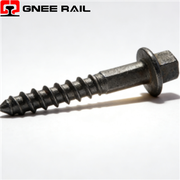
All these components are anchored to the sleeper or foundation using anchors, bolts or screw spikes, depending on the track structure. In concrete sleepers, cast-in shoulders or embedded anchors provide fixing points for the clips. In timber sleepers, screw spikes or sleeper screws fasten baseplates and guide plates. In slab track and crane rail systems, high-strength anchor bolts fix baseplates directly to the concrete foundation. In jointed track and special trackwork, rail anchors or anti-creep devices control longitudinal rail movement caused by traction forces and thermal expansion.
Frequently Asked Questions
1. What is toe load in a rail fastening system?
Toe load is the vertical force that the clip toe applies to the rail foot. It must be high enough to hold the rail down and prevent uplift under traffic, yet controlled so the rail is not over-constrained. Consistent toe load across a line is a key quality indicator of a well-installed fastening system.
2. Why is a rail pad needed under the rail?
The pad cushions the rail seat, spreads the wheel load, damps vibration and often provides electrical insulation. Without a pad, the rail would bear directly on the concrete or timber, causing cracking, crushing and rapid wear of the sleeper.
3. When is a baseplate (tie plate) used instead of direct fixing?
A baseplate is used where the rail must be raised, where load distribution over the sleeper must be improved, or where clip positioning and gauge control need a precise interface - typical of concrete sleeper, turnout and crane rail track. Direct fixing is used on timber sleepers with screw spikes or on slab track with anchor bolts.
4. Why is electrical insulation part of the fastening function?
In electrified and signaled track, the rail is part of the return circuit or track circuit. Insulating pads and insulators stop current from leaking into the sleepers, reinforcement or ground, which would corrode the steel and disturb train detection.
5. Can fastening components be mixed across systems?
No. Each fastening system is designed as a matched set of clip, shoulder, pad and insulator. Mixing components from different systems changes toe load, gauge behaviour and insulation performance, so a fastening system should be supplied and installed as an integrated package.
6. What determines the fastening spacing on track?
Spacing is determined by the rail section, axle load, speed and sleeper type, and is set by the track standard. Closer spacing reduces rail bending stress but increases cost; the fastening system must match the spacing for which the rail and sleepers are designed.