


What is the size of a standard railroad rail?
Jan 22, 2026
A steel rail is a fundamental component of rail infrastructure, serving as the interface between rolling stock and track while ensuring safe load distribution, guidance, and long-term serviceability. GNEE RAIL supplies all-standard steel rails globally, including QU70–QU120, DIN536 A55–A120, UIC50–UIC60, JIS 15KG–50N, AS1085 31–89kg, AREMA/ASCE 25–175 lb, and provides comprehensive services from customized fabrication, heat treatment, coating, and precision cutting to track system consulting, installation support, and post-sale technical assistance.
What is the size of a standard railroad rail?
A standard railroad rail's "size" refers mainly to its gauge (width), which is internationally 1,435 mm (4 ft 8 1/2 in), and its profile (weight/height), with common US types like 115RE (115 lbs/yard) or heavier 136RE, while lengths vary from standard 39ft to much longer welded sections.
Rail Gauge (Width Between Rails)
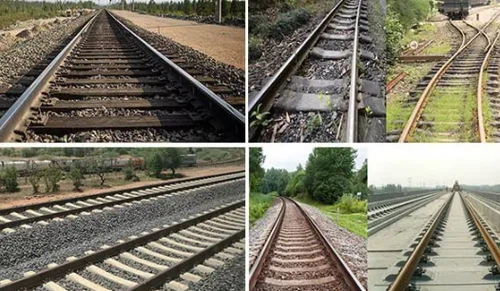
- Standard Gauge: 1,435 mm (4 ft 8 1/2 in) is the global standard, used by about 55-60% of railways.
- US Standard: Also 4 ft 8 1/2 in, with slight variations allowed by safety standards (e.g., 4 ft 8 in to 4 ft 9 1/2 in).
Rail Profile (Cross-Section)
This describes the rail's weight and dimensions, varying by region and use.
US Examples (AREMA standards):
- 115RE: 115 pounds per yard (approx. 57 kg/m).
- 136RE: 136 pounds per yard (approx. 67.5 kg/m).
- 90RA: 90 pounds per yard (approx. 44.6 kg/m).

| ASTM standard, AREMA standard | ||||||
|---|---|---|---|---|---|---|
| Size | Dimension(mm) | Weight (kg/m) |
Length(m) | |||
| Head | Height | Foot | Thickness | |||
| ASCE 25 | 38.1 | 69.85 | 69.85 | 7.54 | 12.4 | 6-12 |
| ASCE 30 | 42.86 | 79.38 | 79.38 | 8.33 | 14.88 | |
| ASCE 40 | 47.62 | 88.9 | 88.9 | 9.92 | 19.84 | |
| ASCE 60 | 60.32 | 107.95 | 107.95 | 12.3 | 29.76 | |
| ASCE 75 | 62.71 | 122.24 | 122.24 | 13.49 | 37.2 | 12-25 |
| ASCE 85 | 65.09 | 131.76 | 131.76 | 14.29 | 42.17 | |
| ASCE 90 | 69.09 | 130.18 | 142.88 | 14.29 | 44.65 | |
| ASCE 115 | 69.06 | 139.7 | 168.28 | 15.88 | 56.9 | |
| ASCE 136 | 74.61 | 152.4 | 185.74 | 17.46 | 67.41 | |
| ASCE 175 | 109.86 | 152.4 | 152.4 | 38.1 | 86.8 | |
Other Types of Steel's Specification
As a professional rail fastener supplier, GNEE RAIL can provide different standard steel rail such as GB,American, BS, UIC, DIN, JIS, Australian and South Africa which used in railway lines, cranes and coal mining.

| Standard | Sepc. | Material Typical Grade |
| UIC860 | UIC54 | 700,900A,900B |
| UIC60 | ||
| EN13674.1 | 5.00E+02 | R200,R350HT,R260Mn,R35LHT,R320Cr,R370CrHT |
| 5.40E+02 | ||
| 6.00E+02 | ||
| 6.00E+03 | ||
| BS-11-1985 | BS80A | 700,900A,900B |
| BS90A | ||
| BS100A | ||
| AREMA | 115RE | SS,HH,LA,IH |
| 136RE | ||
| ASCE60 | U71Mn | |
| ASCE85 | U71Mn | |
| GB 2585-2007 | 50kg/m | U71Mn |
| 60kg/m | U75V | |
| 75kg/m | ||
| TB/T2344-2012 | 50kg/m | U71Mn,U75V,U77MnCr |
| 60kg/m | U78CrV | |
| 75kg/m | ||
| GB 11264-1989 | 8kg/m | Q235 |
| 12kg/m | Q235 | |
| 15kg/m | 55Q, Q235 | |
| 18kg/m | 55Q, Q235 | |
| 22kg/m | 55Q, Q235 | |
| 24kg/m | 55Q, Q235 | |
| 30kg/m | 55Q, Q235 | |
| 38kg/m | 50Mn, U71Mn | |
| 43kg/m | 50Mn, U71Mn | |
| GB Crane rails | QU70 | U71Mn |
| QU80 | U71Mn | |
| QU100 | U71Mn | |
| QU120 | U71Mn |
What is the function of steel train rails?
The primary function of steel train rails is to guide train wheels and provide a smooth, continuous, low-friction surface for movement, while also transferring and distributing the immense weight of the train to the track structure (sleepers, ballast, subgrade) below. They act as strong, durable I-beams, with their head supporting the wheels and their web and flanges transmitting loads, preventing derailments and ensuring safe, efficient transport of people and goods.
Key Functions:

Guidance: Rails keep wheels aligned and prevent them from moving laterally, ensuring the train stays on track.
Load Distribution: They spread the heavy vertical and dynamic forces from the train wheels over a much larger area of the track bed.
Running Surface: They offer a smooth, hard, and consistent path with very low friction, allowing for high speeds and energy efficiency.
Structural Support: Rails withstand immense stress, wear, and fatigue from constant use, acting as a foundational element of the railway system.
Key Characteristics:
- High Strength & Durability: Made from high-grade steel to resist deformation and wear.
- Shape: The I-beam shape (head, web, foot) is crucial for supporting loads and distributing them.
- Material Properties: Require high hardness, tensile strength, fatigue strength, and toughness.
Since 2008, GNEE RAIL has been supplying steel rails of different grades for more than 18 years, steel rails from GNEE is highly recommened in China and abroad.Wtih cutting edge equipment, GNEE produces high quality steel rails that meet with requirements of most countries. Standard rail, head hardened rail, heavy rail,light rail,crane rail and other types are all available here, as one of the China main rail supplier, GNEE RAIL has been working on supplying economical green railway products all over the world.


