


Railroad Gauge Baffle - Gauge Apron Plate
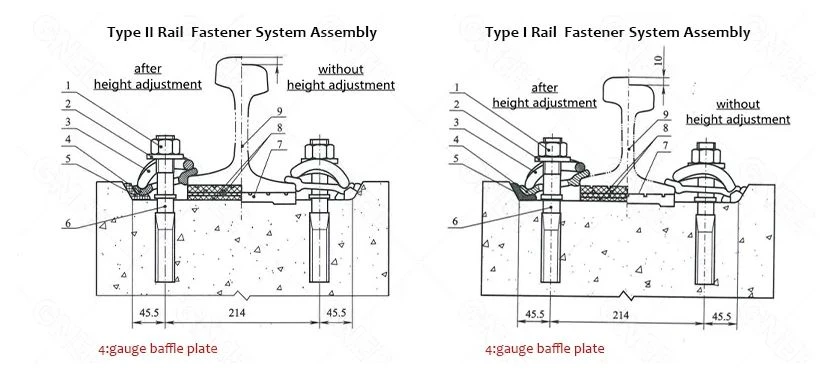
Rail gauge baffles, is also called clamping bar, one type of the railway fasteners, is made of railway hot-rolled gauge baffle steel ,Q235-A. It is used together with rail elastic clips, sleeper screws, nuts, flat washers, rail insulators and rail rubber pad to adjust the gauge distance, transmit the horizontal thrust of the rail, and maintain the standard gauge.
No Information
Railroad Gauge Baffle - Gauge Apron Plate
Rail gauge baffles, is also called clamping bar, one type of the railway fasteners, is made of railway hot-rolled gauge baffle steel ,Q235-A. It is used together with rail elastic clips, sleeper screws, nuts, flat washers, rail insulators and rail rubber pad to adjust the gauge distance, transmit the horizontal thrust of the rail, and maintain the standard gauge.
Gauge baffles are mostly used in railway construction, mainly for standard gauge straight lines and prestressed concrete tracks with a radius of ≥300m and curves of 50 and 60kg/m rail lines.
According to its shape and specific object of action, the gauge baffle is divided into various types, joint gauge apron, intermediate gauge apron, height-adjusting gauge baffle and heavy-duty gauge apron.and there are many commonalities between each type, but there are differences in the detailed requirements.

GNEE RAILWAY RAILWAY provides gauge apron plate in Plain, Oxide Black, Sherardizing, Nitriding, Dacromet, Galvanized and Sherardizing Nnickel for customers to choose.
Specifications of Rail Baffle Plate
Gauge baffle plates(railway guide plates) are often used for Type-I and Type-II railway fastening systems to fix the connection between rails and sleepers. The raw materail for raiwlway guide plates is a kind of special-shaped section steel, which is produced by hot rolling method.
GNEE RAILWAY RAILWAY provides gauge apron plate in Plain, Oxide Black, Sherardizing, Nitriding, Dacromet, Galvanized and Sherardizing Nnickel for customers to choose.
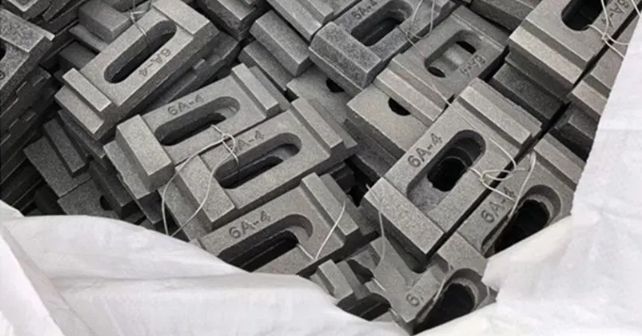

- The implementation standard of gauge baffle steel is YB/T2010-2003.
- The 6# and 10# guide plates follow TB/T3065-2020;
- The 14# and 20# guide plates follow TB/T1495-2020. In addition, the standards are also implemented at the same time: Q/CR563, Q/CR564.
The grade, chemical composition, tensile and cold bending properties of baffle steel shall comply with the requirements of Q235A and Q235B grade steel in GB/T 700 standard.
| Material | Chemical composition/%, not more than |
Tensile test, not less than | Cold bending test 180°, B=2a | ||||||
| C | Mn | Si | S | P | ReH/ MPa | Rm/ MPa | A/% | Bending diameter d | |
| Q235A | 0.22 | 1.40 | 0.35 | 0.045 | 0.045 | 235 | 370~500 | 26 | a (longitudinal) |
| Q235B | 0.20 | 1.40 | 0.35 | 0.045 | 0.045 | 235 | 370~500 | 26 | a (longitudinal) |
How is the Railroad Gauge Baffle manufactured?
Railroad gauge baffles are manufactured by hot-rolling special-shaped section steel, such as Q235A, into the desired shape and then assembling them with other components like clips, insulators, and pads to create the complete fastening system. Some baffles use a composite construction method, where rigidized felt is compressed between carbon composite panels, and the thickness can be adjusted to specific needs.

Steel manufacturing process
- Material preparation: The manufacturing process begins with a special-shaped section steel, often Q235A grade, which is chosen for its durability and strength.
- Hot rolling: The steel is formed using a hot rolling method to create the specific shape of the gauge baffle plate.
- Assembly: The hot-rolled baffle plates are then used in conjunction with other components to form the complete rail fastening system. This includes rail elastic clips, sleeper screws, nuts, washers, insulators, and rubber pads.
- Quality control: The final products must comply with specific standards, such as those outlined in YB/T2010-2003 for properties like chemical composition and mechanical strength.
Quality requirements of Rail Gauge Baffle
1. The surface should be flat and free of cracks. The contact surface between the gauge baffle and the rail and the baffle seat should not have burrs or protrusions that affect the use.
2. In terms of anti-rust performance and marking, the gauge baffle plate after anti-rust treatment should meet the dimensional accuracy and performance requirements, and meet the requirements of rail gauges used in different areas such as general areas, coastal areas, areas with severe acid rain corrosion, and coastal areas with severe acid rain corrosion. The distance baffles should be distinguished by different symbols and colors.
3. In addition to the appearance, when inspecting the gauge baffle, the main attention should be paid to the width of the baffle, the horizontal distance from the center of the hole to the center of the R15 circle, the height of a corner, the flatness of the contact surface between the baffle and the rail, the symmetry of the hole, Cutting angle, etc.

How to choose the right Rail Gauge Baffle Plates?
To choose the right Rail Gauge Baffle Plates, match the baffle's design (holes, size) to your specific track gauge, ensure it meets material standards (like Q235A/B) for strength and corrosion resistance in your environment (coastal, industrial), confirm it adheres to rail safety standards (like AREMA/EN) for load and speed, and check for compatibility with your fastener system, prioritizing durability, proper fit, and compliance.
1. Identify Your Track Gauge & System:
- Gauge Size: Confirm your track's exact width (Standard, Broad, Narrow).
- Baffle Type: Select baffles with the correct hole pattern (e.g., square for Type-III, oblong for Type-VI) and dimensions (width, hole center distance) to fit your specific rail and sleeper setup.

2. Material & Environmental Considerations:
- Material Grade: Choose baffles made from appropriate steel (like Q235A/B) for necessary strength and cold bending properties.
- Corrosion Protection: Select coatings (Galvanized, Dacromet, Sherardized, etc.) suitable for your environment (general, coastal, acid rain prone).
- Durability: Look for designs that withstand harsh weather, heavy loads, and vibrations.
3. Safety & Performance Standards:
- Compliance: Ensure baffles meet relevant national or international standards (e.g., YB/T2010-2003, TB/T3065-2020, AREMA, EN).
- Load Capacity: Verify they can handle the dynamic forces from heavy, high-speed trains.
4. Fastener Compatibility:
- System Fit: Confirm the baffle's hole size and shape match your existing or planned rail fastening system components (baseplates, clips).
Key Checklist When Choosing:
- Dimensions: Correct width, hole size, R15 circle distance.
- Material: Steel grade and anti-rust coating.
- Standards: Adherence to rail safety and quality norms.
- Application: Suitability for traffic volume, speed, and environmental conditions.
rail fastening Packaging & Delivery
For railway fasteners with high thread accuracy requirements (such as precision bolts, adjustment nuts), the packaging must prioritize the protection of the thread structure. First, rigid plastic protective caps are fitted onto the threads. The inner wall of the caps conforms to the thread pattern, preventing thread deformation caused by impact during transportation. Then, the products with protective caps are placed into individual slots made of EPE (expanded polyethylene) foam. The slot depth matches the product length, ensuring no loosening after the product is embedded. Multiple slots are neatly arranged in high-strength honeycomb cardboard boxes. The inner walls of the boxes are lined with moisture-proof aluminum foil paper, and silica gel desiccant is placed in the corners. After the box lid is tightly closed, wide strapping bands are used for "cross-shaped" strapping to enhance the overall stability of the packaging.


GNEE RAILWAY RAILWAY, as an industry benchmark in railway fasteners, is equipped with density testers to ensure uniform material quality of products. The railway fasteners we produce effectively absorb track impact and reduce noise levels. Simultaneously, we support customized services for customers, providing full-process support from demand analysis, product development to logistics distribution.


Hot Tags: railroad gauge baffle - gauge apron plate, China railroad gauge baffle - gauge apron plate manufacturers, suppliers, factory


Send Inquiry
