What is the difference between S18 and S20 rail dimensions?
Apr 23, 2026
What is the difference between S18 and S20 rail dimensions?
The primary difference between S18 and S20 rail dimensions lies in their total height and weight, both of which are defined by the DIN 5901 standard. While the S18 rail has a height of 90 mm and a weight of 18.30 kg/m, the S20 rail is taller at 100 mm and heavier at 19.80 kg/m. These differences, though appearing minor, dictate the rail's vertical stiffness and its compatibility with specific crane wheels and fastening systems.

- Profile Height: The S20 rail profile is 10 mm taller than the S18, providing a higher moment of inertia and greater resistance to bending under load.
- Linear Mass: The S20 steel rail weight is 1.50 kg heavier per meter than the S18, making it a more robust choice for permanent industrial installations.
- Base and Head Proportions: Both rails feature similar base-to-height ratios to maintain stability, but the S20's larger dimensions allow for a higher S20 rail load capacity compared to the S18.
- Application Scope: S18 is often chosen for very light trolley systems or temporary tracks, whereas the DIN 5901 S20 rail is the standard for light-duty gantry cranes and mining infrastructure.
How Do the S18 and S20 Profiles Compare Geometrically?
The S18's 90 mm height makes it slightly more compact, which can be an advantage in extremely height-restricted tunnels. However, the S20's 100 mm height provides significantly better support for axle loads up to 3.5 tons.
The base width also scales accordingly: the S18 typically features an 80 mm base, while the S20 expands to 82 mm for added lateral stability.

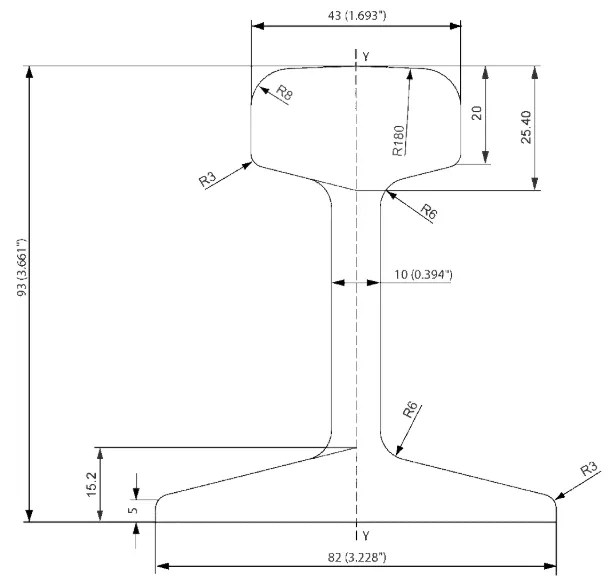
| Size
* |
Rail height(mm)
A |
Bottom Width(mm)
B |
Head Width(mm)
C |
Web Thickness(mm)
t |
Weight(kg/m)
* |
| S10 | 70 | 58 | 32 | 6 | 10 |
| S14 | 80 | 70 | 38 | 9 | 14 |
| S18 | 93 | 82 | 43 | 10 | 18.3 |
| S20 | 100 | 82 | 44 | 10 | 19.8 |
| S24 | 115 | 90 | 53 | 10 | 24.4 |
| S30 | 108 | 108 | 60.3 | 12.3 | 30.03 |
GNEE RAIL produces both the S18 and S20 profiles to exact international tolerances, ensuring that the S20 rail mechanical properties and S18 technical data meet the safety requirements of modern factories.
Why Is the S20 Profile More Common in Modern Mining?
In modern mining, the DIN 5901 S20 rail has largely surpassed the S18 due to its superior durability in damp and corrosive underground environments. The thicker 7 mm web and 100 mm height provide a higher safety margin against corrosion-induced thinning.
Furthermore, the S20 rail material grade (typically 55Q) used in these rails ensures the 30 mm head width resists the abrasive wear caused by grit and ore dust more effectively than the lighter S18 profile.

| 55Q | Mechanical property | Chemical composition(%) | |||||||||
| Yield strength | Tensile strength | Elongation | Hardness | C | Si | Mn | S | P | |||
| MPa | kg/mm² | MPa | kg/mm² | min | HBW | ≤ | ≤ | ||||
| ≥ | ≥ | ≥ | ≥ | ≥ | |||||||
| 685 | 69 | 197 | 0.50-0.60 | 0.15-0.35 | 0.60-0.90 | 0.04 | 0.04 | ||||
The S20 light steel rail has become the standard "heavy-duty light rail" for mining loops because it fits the common axle loads of modern 3-ton to 5-ton mining locomotives.
How to select the appropriate rail specification?
Selecting the appropriate steel rail specification requires balancing axle loads, traffic density, speed, and environmental conditions to ensure safety, durability, and cost-effectiveness. The selection process is primarily driven by weight-per-meter (e.g., 60kg/m) and steel grade (hardness).
Key Selection Factors
- Axle Load and Traffic Volume: The most critical factor. Heavy-haul railways (axle loads ≥25t) require heavy rails (e.g., 60kg/m or 75kg/m) to prevent structural failure, while light freight or industrial sidings may use 30kg/m–43kg/m rails.
- Operating Speed: High-speed lines (>250 km/h) demand precision-engineered, heavy rails (usually 60kg/m) with high fatigue resistance and superior smoothness.
- Track Geometry (Curves and Slope): Tight curves experience higher lateral forces and abrasive wear. In such areas, head-hardened (HH) or heat-treated alloy steel rails (e.g., U75V, U76CrRE) are required to resist wear and fatigue.
- Environmental Conditions: Coastal or marine environments necessitate corrosion-resistant materials or specialized protective coatings. In cold climates, standard carbon steel often performs better than high-strength alloys, which can become brittle.
FAQ
- Is S20 rail 10 mm taller than S18?
Yes, the S20 rail profile has a standard height of 100 mm, while the S18 profile is 90 mm high according to the DIN 5901 standard.
- Which rail is better for a 3-ton overhead crane?
The S20 rail load capacity is better suited for a 3-ton crane, as it provides greater vertical stiffness and a more robust running surface compared to the S18.
- What is the exact weight of S20 rail?
The precise S20 steel rail weight is 19.80 kg per meter, whereas the S18 rail weighs 18.30 kg per meter.
- Are the head widths the same for S18 and S20?
In many standard versions, both have a 30 mm head width, but the S20 has a deeper head and thicker web to handle higher stresses.
GNEE RAIL provides a full range of steel rails, from light-duty profiles to heavy-duty rail, ensuring a precise match for any industrial requirement. We offer professional customization services, including precision cutting to specific lengths and custom hole drilling to match your unique S20 rail drawing layouts.
Click here to submit your project requirements and get a quotation.