What is the height of an S20 rail profile?
Apr 24, 2026
What is the height of an S20 rail profile?
The exact height of an S20 rail profile is 100.00 mm, as strictly defined by the DIN 5901 standard. This specific height is a core feature of the profile's geometry, providing the necessary vertical rigidity to support light-duty industrial loads while maintaining a compact size suitable for space-constrained environments.

- Vertical Stiffness: The 100 mm height ensures a high moment of inertia, allowing the rail to resist bending and deflection when subjected to axle loads typically ranging from 2.5 to 3.5 tons.
- Clearance for Fasteners: This height provides ample "fishing space" between the head and the base, which is essential for the secure fitment of an S20 rail fishplate or joint bar.
- System Stability: When combined with the 82 mm base width, the 100 mm height creates a stable cross-section that prevents the rail from tilting under the lateral forces generated by moving machinery.
- Standardized Compatibility: Because the height is fixed by the DIN 5901 standard, the S20 rail remains compatible with a wide range of international crane wheels and fastening clips.
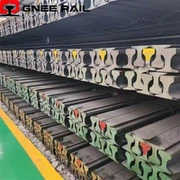
GNEE RAIL produces light rails that strictly adhere to these precise S20 rail dimensions, ensuring that every section of track provides a uniform height for smooth, vibration-free operation.
How Does Rail Height Impact the S20 Rail Load Capacity?
The height of a rail, such as the DIN 5901 S20 rail (commonly with a 100 mm height), is a critical factor directly determining its structural load capacity, bending strength, and vertical stiffness. For the S20 rail, which is a medium-duty rail, higher rail profiles allow for better distribution of vertical pressure, reducing deformation and improving stability.
Impact of Rail Height on S20 Load Capacity:

- Increased Bending Strength: A taller S20 rail provides higher resistance to bending under heavy vertical loads. This rigidity is crucial for maintaining track geometry, especially under high axle loads.
- Reduced Deflection: Increased height adds rigidity, minimizing vibration and deflection (sagging) between sleepers. This allows the rail to handle heavier loads without permanent deformation.
- Improved Load Distribution: A greater rail height allows the load to be distributed over a wider area of the rail base (e.g., 82mm for S20), which helps transfer force more efficiently to the fastening systems and sleepers.
- S20 Specifics: The DIN 5901 S20 rail typically has a height of 100 mm, a weight of 19.8 kg/m, and is designed to handle medium-duty loads in industrial, crane, and logistics applications.
Relationship Between Height and Other Factors:
- Web Thickness: A taller rail is often accompanied by a thicker web to withstand higher vertical pressure and prevent buckling, which enhances the overall strength of the S20 rail.
- Compatibility: While increasing height increases strength, the rail height must be chosen to match the specific, standardized S20 fastening systems and fishplates to ensure proper installation.
What Are The Exact DIN 5901 S20 RAIL Dimensions?
DIN 5901 S20 rail (also known as S20 light steel rail) is a European standard light-duty rail used for industrial, mining, and crane tracks, with a weight of 19.8 kg/m and standard dimensions: 100 mm height, 82 mm base width, 44 mm head width, and a 10 mm web thickness.

| Size | Rail height(mm)
A |
Bottom Width(mm)
B |
Head Width(mm)
C |
Web Thickness(mm)
t |
Weight(kg/m)
* |
| S10 | 70 | 58 | 32 | 6 | 10 |
| S14 | 80 | 70 | 38 | 9 | 14 |
| S18 | 93 | 82 | 43 | 10 | 18.3 |
| S20 | 100 | 82 | 44 | 10 | 19.8 |
| S24 | 115 | 90 | 53 | 10 | 24.4 |
| S30 | 108 | 108 | 60.3 | 12.3 | 30.03 |
FAQ
- What is the exact height of an S20 rail?
The exact height is 100.00 mm, which is the standard dimension for S20 rails under the DIN 5901 standard.
- Can I use S20 rail if my current track is 90 mm high?
No, rails of different heights cannot be joined directly without specialized transition plates. The 100 mm height of the S20 rail profile must be matched to ensure a level running surface.
- Does the height affect the S20 rail weight per meter?
Absolutely. The 100 mm height, along with the head and base widths, determines the volume of steel, resulting in the standard S20 steel rail weight of 19.80 kg/m.
- Is the height of S20 rail measured from the base to the top?
Yes, the 100 mm height represents the total vertical dimension of the S20 rail cross section, from the bottom of the base to the highest point of the rail head.
- How does the height contribute to RAIL S20 MATERIAL STRENGTH?
A taller rail profile increases the moment of inertia, which significantly enhances the rail's ability to resist bending under vertical loads, contributing to overall system safety.
GNEE RAIL provides a comprehensive range of steel rails, from light-duty tracks to heavy infrastructure, ensuring a precise match for any industrial requirement. We offer professional customization services, including precision cutting to specific lengths and custom hole drilling to match unique track layouts. Our supply chain includes all necessary matched fasteners and joint bars, and we leverage extensive global logistics experience to ensure that every order of DIN 5901 S20 rail arrives securely and on time at its destination.
Click here to get the latest price of S20 Rail.