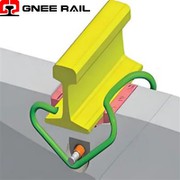
What is the purpose of a rail pad under QU120 crane rails?
Sep 17, 2026

What is the purpose of a rail pad under QU120 crane rails?
Rail pads installed under QU120 crane rails serve as critical resilient buffers between the heavy crane rail and its supporting structure, with core functions centered on load distribution, vibration damping, and wear protection. For QU120 crane rail applications, these elastic rail pads distribute concentrated wheel loads across a wider contact surface, eliminating localized stress concentrations that can cause fatigue damage to both the rail and the underlying concrete or steel support structure. They also absorb vertical impacts and horizontal thrusts generated during crane starting, stopping, and turning, while compensating for minor unevenness in contact surfaces to maintain consistent rail alignment.
-
Detailed Functions in QU120 Crane Track Systems
QU120 crane rail rubber pads are engineered to handle the high wheel pressures and frequent start-stop cycles typical of overhead crane, gantry crane, and port yard applications. Unlike standard railway rail pads, crane rail rubber pads for QU120 profiles are designed with a slightly convex cross-section to ensure even force distribution across the pad surface, and many models feature embedded steel plates to enhance load-bearing capacity and extend service life. Surface patterns such as diamond grooves or textured finishes increase friction between the pad and both the rail base and the support structure, preventing rail slippage during dynamic crane movements.
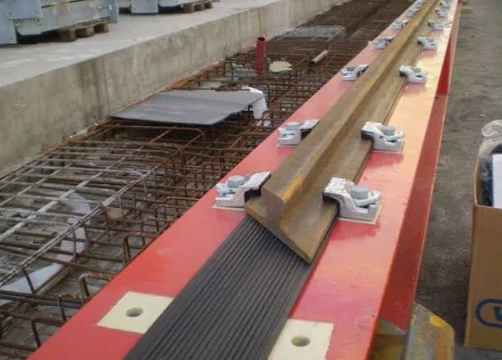
The elastic rail pad also plays a key role in reducing metal-to-metal wear between the QU120 rail foot and the supporting beam, cutting down on maintenance requirements for both the rail and the runway structure. By dampening structural vibration and reducing friction noise, these pads create a safer, more comfortable working environment in industrial workshops and port facilities. For QU120 crane rail systems, pad thickness typically ranges from 5 mm to 20 mm, adjusted based on specific wheel load requirements to balance cushioning performance and structural stability.
-
Material and Design Characteristics
QU120 crane rail pads are commonly manufactured from synthetic rubber blends, often combining natural rubber with NBR for improved oil resistance, carbon black for reinforcement, and vulcanizing agents to enhance structural integrity. Optional materials include SBR for high wear resistance and cost efficiency, EVA for lightweight impact absorption, and PU composite rubber for applications requiring superior abrasion performance. These materials deliver reliable performance across operating temperatures from -50 °C to 70 °C, with resistance to UV exposure, oxidation, water, oil, and grease to suit both indoor and outdoor crane track environments.
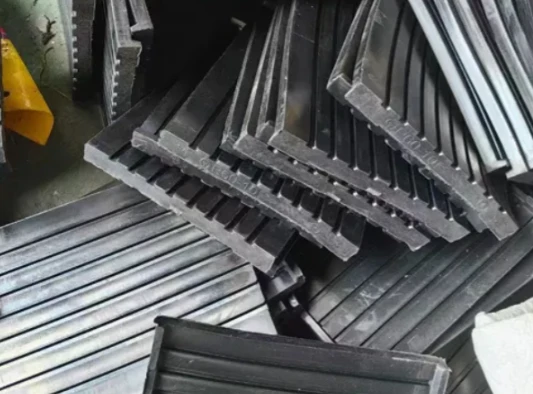
Grooved designs are available for QU120 crane rail rubber pads to tailor load-deflection characteristics, with low initial stiffness ensuring the pad maintains intimate contact with the rail even during vertical rail movements, while sufficient stiffness under full wheel load prevents excessive displacement that could loosen fastening components. For long-span crane systems with particularly heavy loads, multi-layer composite structures combining rubber with steel mesh cores are used to boost rigidity without sacrificing damping performance.
| Mechanical properties of the Rubber Rail Pad | ||
| Technical Parameter | Unit | Value |
| Stiffness | KN | 90-130 |
| Hardness Shore A | ℃ | 72-80 degree |
| Electronic Resistance | Ω | ≥ 106 |
| Tensile Strength before Aging | Mpa | ≥12.5 |
| Elongation before Aging | % | ≥250 |
Compatibility and Installation Considerations
For QU120 crane rails, PA7-168 model rail pads with a width of 168 mm are specifically matched to the rail base dimensions, ensuring full coverage of the rail foot for optimal load distribution. These pads are available for both continuously supported rail installations and discontinuous mounting configurations, with standard lengths of 12 m and custom lengths available to suit specific project requirements. Proper installation begins with cleaning the support surface to remove oil and debris, then laying the pad flat before positioning the rail and securing the fastening system to specified torque values.
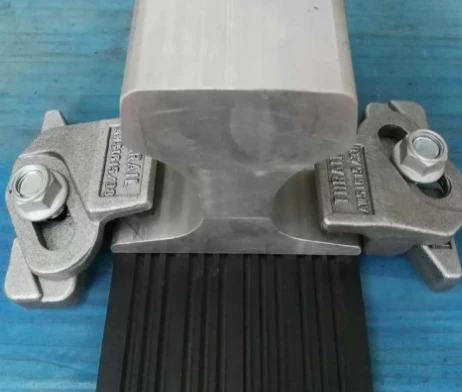
GNEE RAILWAY supplies QU120 crane rail pads alongside a full range of matching crane track components, including rail clips, bolts, and tie plates, all engineered for consistent compatibility to simplify procurement and installation. Every product undergoes strict quality control checks for dimensional accuracy, compression performance, and material properties to ensure reliable long-term performance under heavy crane operating conditions.
FAQ
Q1. Which standard does the Rail Pad follow?
It follows UIC, AREMA, TB/T 2626-95 (rubber pads for concrete sleepers); also used across E-type, SKL, KPO, Nabla PR, Russian and Fastclip fastening systems, and UIC / BS / JIS rail standards. Expanded third-sou. Dimensions and tolerances are controlled to that standard, and the mill certificate can be provided on request.
Q2. What material is used for the Rail Pad?
The material is Rubber, EVA, TPEE, HDPE (EPDM and polyurethane also used for rail pads); rubber pads mainly composed of natural rubber, styrene, chloroprene and HDPE.. The exact grade can be adjusted according to your drawing and service condition.
Q3. Can GNEE RAILWAY customize this product?
Yes. GNEE RAILWAY can produce according to customer drawings and specific requirements, with confirmation on details before production.