Is a rail pad mandatory for QU120 crane rail applications?
Sep 17, 2026

Is a rail pad mandatory for QU120 crane rail applications?
For QU120 crane rail applications, a rail pad is a highly recommended, functionally critical component rather than a universally mandatory part by all global standards, but it becomes a de facto requirement for nearly all heavy-duty crane runway systems due to the extreme wheel loads, frequent start-stop cycles, and impact forces inherent to QU120 rail service.
QU120 crane rails carry heavy overhead and gantry crane loads, with wheel-rail contact stresses that can cause rapid wear, fatigue damage, and foundation degradation without proper cushioning. A QU120 crane rail pad distributes concentrated wheel loads over a larger support surface, absorbs vertical impacts and horizontal thrusts, and compensates for minor unevenness between the rail base and the supporting concrete or steel structure. Without an elastic rail pad, metal-to-metal contact between the rail foot and the foundation accelerates abrasion, increases structural vibration, and shortens the service life of both the rail and the runway structure.
Core Functions of QU120 Crane Rail Pads
A QU120 crane rail rubber pad serves multiple key roles that directly support the reliability of heavy crane operations.
- First, it distributes wheel loads across a wider contact area, eliminating localized stress concentration that can lead to fatigue cracking in the rail base or crushing of the supporting concrete beam.
- Second, it provides vibration damping and shock absorption, reducing the dynamic forces generated during crane acceleration, deceleration, and lifting operations. This vibration reduction also lowers structure-borne noise, creating a safer and more comfortable working environment in workshops, ports, and storage yards.
- Third, the crane rail rubber pad compensates for small irregularities in the mounting surface, ensuring consistent, intimate contact between the rail and its support to prevent uneven wear and rail movement.

It also acts as a sealing layer between the rail bottom and the support surface, reducing the ingress of dust, water, and oil that could accelerate corrosion or abrasion.
Material and Structural Design for QU120 Applications
QU120 crane rail pads are engineered to withstand the specific demands of heavy crane service, with material formulations and structural designs tailored to high wheel pressures and harsh operating conditions. Most QU120-specific pads use synthetic rubber blends, primarily natural rubber combined with NBR for enhanced oil resistance, carbon black for reinforcement, and vulcanizing agents to improve crosslink density and durability.
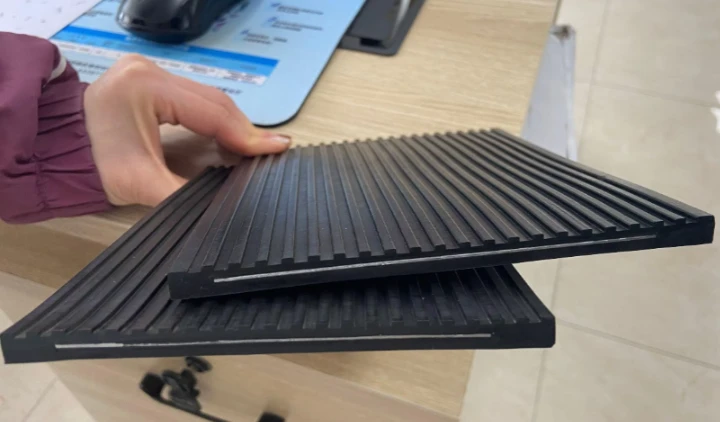
For applications requiring superior wear resistance, PU composite rubber may be used, while EVA and HDPE options are available for lighter-duty or specialized installation requirements. The PA7 series pad designed for QU120 rails has a width of 168 mm, matched precisely to the QU120 rail base dimensions for proper load distribution. Structurally, these pads feature a slightly convex cross-section to optimize force distribution, and many include embedded steel plates to increase load-bearing capacity and extend service life. Surface textures such as diamond patterns or grooves improve friction between the pad, rail, and foundation to prevent slippage, while multi-layer composite structures with rubber and steel mesh cores are available for long-span, high-load crane systems.
Performance and Operating Specifications
Elastic rail pads for QU120 crane rails deliver consistent performance across a wide range of operating conditions, with thickness typically ranging from 5 mm to 20 mm to match specific wheel load requirements. Thicker pads provide greater cushioning and vibration isolation, while thinner pads maintain a lower track profile for applications with limited vertical clearance. Rubber crane rail pads offer hardness values between 72 and 80 Shore A, with stiffness ranging from 90 to 130 kN, and maintain reliable performance in operating temperatures from -50°C to 70°C.
They exhibit strong resistance to aging, abrasion, water, oil, grease, mildew, and fungus, making them suitable for both indoor workshop environments and outdoor port or storage yard installations. These pads also provide electrical insulation between the rail and the supporting structure, which supports safety and signal system performance where applicable.
GNEE RAILWAY supplies QU120 crane rail pads alongside a full range of matching crane rail components, including rails, clips, bolts, and joint bars, all tested for consistent quality and perfect compatibility. This coordinated supply eliminates the risk of mismatched parts from multiple suppliers, simplifying procurement and reducing installation delays.
FAQ
- What is the purpose of a rail pad under QU120 crane rails?
A rail pad under QU120 crane rails distributes heavy wheel loads over a larger support area to reduce stress concentration, absorbs impact and vibration from crane start-stop cycles, and compensates for minor unevenness in the mounting surface. It also minimizes wear between the rail base and the foundation, lowers structure-borne noise, and extends the service life of both the rail and the runway structure.
- What materials are QU120 crane rail pads made of?
Most QU120 crane rail pads are made from blended synthetic rubber, typically combining natural rubber with NBR for oil resistance, carbon black for reinforcement, and vulcanizing agents for improved durability. PU composite rubber is used for enhanced wear resistance in heavy-duty applications, while EVA and HDPE options are available for lighter-duty or specialized installation needs.
- How thick should a QU120 crane rail pad be?
QU120 crane rail pads typically range in thickness from 5 mm to 20 mm, with the exact thickness selected based on the crane's wheel load and project requirements. Thicker pads provide greater cushioning and vibration isolation, while thinner pads are used where vertical clearance is limited and a lower track profile is needed.
- Can I use a standard rail pad for QU120 crane rail applications?
Standard rail pads designed for general railway use are not recommended for QU120 crane rail applications, as they cannot withstand the high wheel pressures, frequent impact loads, and horizontal thrusts common to heavy crane operations. QU120-specific crane rail pads are engineered with matched widths, reinforced structures, and material formulations tailored to the demands of crane runway systems.