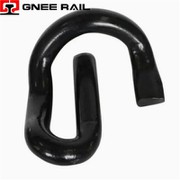
What Are Dog Spikes Used For? Railway Spike Functions and Types
Sep 30, 2025
What Is a Dog Spike?
A dog spike (rail spike, cut spike) is a rail fastening element used to fix the rail base to wooden sleepers. The spike is driven into the sleeper with its tapered body cutting into the wood, while the head clamps the rail foot, holding the rail in position. Because of their simple installation and low cost, dog spikes are widely used on light-railway lines, branch lines, industrial tracks and temporary construction tracks.
Dog Spike Technical Data
| Parameter | Value |
|---|---|
| Standards | AREMA, UIC, or as per customer requirements |
| Type | Dog spike, screw spike |
| Head type / neck type | Multiple / various |
| Function | Rail fixing on track beds |
| Available length | 10-1000 mm |
| Tolerance / surface treatment | Per customer requirements / plain oil, black, HDG, galvanized, etc. |
| Material | Q235, 35, 45, 60, 16Mn, 65Mn, 40Cr, 20MnTiB, 35CrMo, 42CrMo |
| Grade | 3.6, 4.6, 4.8, 5.6, 5.8, 6.8, 8.8, 9.8, 10.9, 12.9 |
| Spike specification | Per customer drawings |
When Are Screw Spikes Preferred?
For heavy-load or high-frequency lines, screw spikes are generally preferred because of their higher holding force and durability. Screw spikes are threaded into pre-installed dowels or directly into the sleeper, providing greater withdrawal resistance than cut spikes, and they are easier to remove and re-install during maintenance. Dog spikes remain the economical choice for timber sleepers on light lines, branch lines and temporary tracks, where installation speed and low cost matter more than maximum holding force.
Dog Spikes in the Fastening System
Dog spikes work together with other track components. In a typical timber-sleeper fastening, the rail sits on a base plate (tie plate) that spreads the load, and the dog spikes clamp the base plate and rail foot to the sleeper. Supplementary components such as rail pads, rail clips and rail anchors are used with spikes to complete the fastening system, and all parts must be matched to the rail section and sleeper type.
Materials, Grades and Protection
Dog spikes are made from low- and medium-carbon steels (Q235, 35, 45, 60), manganese steels (16Mn, 65Mn) and alloy steels (40Cr, 20MnTiB, 35CrMo, 42CrMo) depending on the required strength and the environment. Property classes range from 3.6 up to 12.9. Standard surface treatments include plain oiled, black oxide, electrogalvanized and hot-dip galvanized (HDG) finishes, selected according to humidity and exposure conditions. Spike length, head shape and neck type are specified to the sleeper thickness and rail base design.
FAQ
What is the difference between a dog spike and a screw spike?
A dog spike is driven into the sleeper with a hammer and grips by friction and cutting into the wood; a screw spike is threaded in and provides higher holding force, making it preferred for heavy-load and high-frequency lines.
Where are dog spikes mainly used?
On light-railway lines, branch lines, industrial tracks and temporary construction tracks, where simple installation and low cost are important, and on timber sleepers generally.
What materials are dog spikes made of?
Common materials include Q235, 35, 45, 60, 16Mn, 65Mn, 40Cr, 20MnTiB, 35CrMo and 42CrMo, with surface treatments such as plain oil, black, hot-dip galvanized (HDG) or electrogalvanized.
Which standards apply to dog spikes?
AREMA and UIC are the common standards; spikes can also be manufactured to customer drawings and specifications.
How is a dog spike installed and removed?
A dog spike is driven with a hammer or spike driver and removed with a spike puller. Removal is quick, which is an advantage during re-railing and maintenance, although the holding force is lower than a screw spike.
What surface treatment should I choose for spikes in a humid climate?
Hot-dip galvanizing (HDG) provides the thickest zinc protection and is recommended for humid or coastal environments; plain oiled or black finishes are suitable for dry indoor and low-humidity applications.