What are the quality standards of steel?
Jan 21, 2026
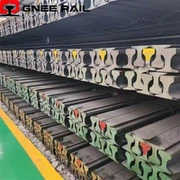
Steel Rails, also known as rail profiles, are the main components of railway tracks. Its function is to guide the wheels of locomotives and vehicles; withstand the enormous pressure of the wheels, and pass pressure force on to rail sleepers.
What are the quality standards of steel?
Steel quality standards define properties like strength, ductility, and composition through systems like ASTM, ISO, and EN, ensuring safety and performance for applications from construction (ASTM A36, EN 10025) to stainless steels (304/316), guiding manufacturing and use for reliability and specific functions. These standards cover chemical makeup, mechanical testing, and fabrication processes, with examples like ASTM A36 for structural steel and ISO 9001 for quality management.
As a professional rail fastener supplier, GNEE RAIL can provide different standard steel rail such as GB,American, BS, UIC, DIN, JIS, Australian and South Africa which used in railway lines, cranes and coal mining.

GB Standard Steel Rail
| Classification | Height(mm) | Head (mm) | Bottom (mm) | Thick(mm) | Weight (kg/m) | |
| Light Rail | 8 KG/M | 65 | 25 | 54 | 7 | 8.42 |
| 9 KG/M | 63.5 | 32.1 | 63.5 | 5.9 | 8.94 | |
| 12 KG/M | 69.85 | 38.1 | 69.85 | 7.54 | 12.2 | |
| 15 KG/M | 79.37 | 42.86 | 79.37 | 8.33 | 15.2 | |
| 18 KG/M | 80 | 40 | 80 | 10 | 18.06 | |
| 22 KG/M | 93.66 | 50.8 | 93.66 | 10.72 | 22.3 | |
| 24 KG/M | 107 | 51 | 90 | 10.9 | 24.46 | |
| 30 KG/M | 107.95 | 60.33 | 107.95 | 12.3 | 30.1 | |
| Heavy Rail | 38 KG/M | 134 | 68 | 114 | 13 | 38.733 |
| 43 KG/M | 140 | 70 | 114 | 14.5 | 44.653 | |
| 45 KG/M | 145 | 67 | 126 | 14.5 | 45.546 | |
| 50 KG/M | 152 | 70 | 132 | 15.5 | 51.514 | |
| 60 KG/M | 176 | 73 | 150 | 16.5 | 60.64 | |
| Crane Rail | QU 70 | 120 | 70 | 120 | 28 | 52.8 |
| QU 80 | 130 | 80 | 130 | 32 | 63.69 | |
| QU 100 | 150 | 100 | 150 | 38 | 88.96 | |
| QU 120 | 170 | 120 | 170 | 44 | 118.1 | |
BS11:1985 Standard Steel Rail
| Standard: BS11:1985 | ||||||
|---|---|---|---|---|---|---|
| Size | Dimension(mm) | Weight (kg/m) |
Length(m) | |||
| Head | Height | Bottom | Thickness | |||
| 50 O | 52.39 | 100.01 | 100.01 | 10.32 | 24.833 | 6-18 |
| 60 A | 57.15 | 114.3 | 109.54 | 11.11 | 30.618 | |
| 75 A | 61.91 | 128.59 | 114.3 | 12.7 | 37.455 | 8-25 |
| 75 R | 61.91 | 128.59 | 122.24 | 13.1 | 37.041 | |
| 80 A | 63.5 | 133.35 | 117.47 | 13.1 | 39.761 | |
| 80 R | 63.5 | 133.35 | 127 | 13.49 | 39.674 | |
| 90 A | 66.67 | 142.88 | 127 | 13.89 | 45.099 | |
| 100 A | 69.85 | 152.4 | 133.35 | 15.08 | 50.182 | |
| 113 A | 69.85 | 158.75 | 139.7 | 20 | 56.398 | |
UIC 860 Standard Steel Rail
| Standard: UIC860 | ||||||
|---|---|---|---|---|---|---|
| Size | Dimension(mm) | Weight (kg/m) |
Length(m) | |||
| Head | Height | Bottom | Thickness | |||
| UIC50 | 70 | 152 | 125 | 15 | 50.46 | 12-25 |
| UIC54 | 70 | 159 | 140 | 16 | 54.43 | |
| UIC60 | 74.3 | 172 | 150 | 16.5 | 60.21 | |
DIN 13674-1-2003 Standard Steel Rail
| Standard:DIN 536 | ||||||
|---|---|---|---|---|---|---|
| Size | Dimension(mm) | Weight (kg/m) |
Length(m) | |||
| Head | Height | Bottom | Thickness | |||
| A55 | 55 | 65 | 150 | 31 | 31.8 | 10-12 |
| A55 | 65 | 75 | 175 | 38 | 43.1 | |
| A75 | 75 | 85 | 200 | 45 | 56.2 | |
| A100 | 100 | 95 | 200 | 60 | 74.3 | |
| A120 | 120 | 105 | 200 | 72 | 100 | |
Australian 1085 Standard Steel Rail
| Standard: AS 1085 | ||||||
|---|---|---|---|---|---|---|
| Size | Dimension(mm) | Weight (kg/m) |
Length(m) | |||
| Head | Height | Bottom | Thickness | |||
| 31KG | 63.5 | 117.5 | 108 | 11.5 | 31.5 | 8-25 |
| 47KG | 70 | 141.3 | 127 | 14.3 | 46.5 | |
| 50KG | 70 | 154 | 127 | 15 | 50.8 | |
| 60KG | 70 | 170 | 146 | 16.5 | 61 | |
| 68KG | 73.4 | 186 | 152 | 17.5 | 67.6 | |
| 73KG | 70 | 157 | 146 | 32 | 73.63 | |
| 86KG | 102 | 102 | 165 | 84.11 | 85.5 | |
| 89KG | 102 | 114 | 178 | 51 | 89.81 | |
JIS E 1103/1101 Standard Steel Rail
| Standard: JIS E 1103/1101 | ||||||
|---|---|---|---|---|---|---|
| Size | Dimension(mm) | Weight (kg/m) |
Length(m) | |||
| Head | Height | Bottom | Thickness | |||
| JIS 15KG | 42.86 | 79.37 | 79.37 | 8.33 | 15.2 | 9-10 |
| JIS 22KG | 50.8 | 93.66 | 93.66 | 10.72 | 22.3 | 9-10 |
| JIS 30A | 60.33 | 107.95 | 107.95 | 12.3 | 30.1 | 9-10 |
| JIS 37A | 62.71 | 122.24 | 122.24 | 13.49 | 37.2 | 10-25 |
| JIS 50N | 65 | 153 | 127 | 15 | 50.4 | 10-25 |
| CR 73 | 100 | 135 | 140 | 32 | 73.3 | 10-12 |
| CR 100 | 120 | 150 | 155 | 39 | 100.2 | 10-12 |
South African Standard Steel Rail
| Standard: ISCOR | ||||||
|---|---|---|---|---|---|---|
| Size | Dimension(mm) | Weight (kg/m) |
Length(m) | |||
| Head | Height | Bottom | Thickness | |||
| 15 KG | 41.28 | 76.2 | 76.2 | 7.54 | 14.905 | 9 |
| 22 KG | 50.01 | 95.25 | 95.25 | 9.92 | 22.542 | 9 |
| 30 KG | 57.15 | 95.25 | 109.54 | 11.5 | 30.25 | 9 |
| 40 KG | 63.5 | 127 | 127 | 14 | 40.31 | 9-25 |
| 48 KG | 68 | 150 | 127 | 14 | 47.6 | 9-25 |
| 57 KG | 71.2 | 165 | 140 | 16 | 57.4 | 9-25 |
What Quality Standards Address?
- Mechanical Properties: Yield strength, tensile strength, ductility, hardness, impact resistance.
- Chemical Composition: Carbon content and alloying elements.
- Application-Specific Needs: Grades for structural, stainless, tool, or alloy steels.
- Manufacturing & Management: Fabrication standards, Factory Production Control (FPC), and Quality Management Systems (QMS) like ISO 9001.
Are steel rails of different standards interchangeable?
No, steel rails from different international standards (like UIC, AREMA, JIS, GB) are generally not directly interchangeable due to significant differences in profile (dimensions, head shape, base width), material composition, and fastener hole patterns, which impact safety, wheel compatibility, and track integrity; mixing them without extensive engineering analysis and special fittings is dangerous and not recommended, though standards-specific components (like fishplates) are designed for their own systems.
Key Reasons for Incompatibility

- Dimensional & Profile Differences: Each standard defines specific rail head, web, and base dimensions, as well as head curvature, affecting how wheels interact with the rail.
- Material & Strength: Different standards specify various steel grades (e.g., carbon-manganese, alloy steels) with varying wear resistance, strength, and fatigue properties, crucial for high-stress railway use.
- Fastener & Joint Issues: Even if profiles seem similar, bolt hole spacing on fishplates (rail joints) and other accessories often differs, preventing secure connections.
- Wheel-Rail Interaction: Incompatible rail profiles can lead to poor wheel contact, causing excessive wear, vibration, and potential derailment.
As a professional rail fastener supplier, GNEE RAIL can provide different standard steel rail such as GB,American, BS, UIC, DIN, JIS, Australian and South Africa which used in railway lines, cranes and coal mining.