


What is a rail rubber pad?
Sep 16, 2026

What is a rail rubber pad?
A rail rubber pad is an elastic component installed between steel rails and sleepers (or supporting structures) to cushion impact, reduce vibration, and protect track infrastructure. It is typically made from natural rubber, synthetic rubbers, EVA, HDPE, or polyurethane, with a hardness range of 72–80 Shore A for standard rubber variants and an operating temperature range of -50 ~ 70 °C. The pad distributes wheel loads over a larger surface, eliminates load concentration, and provides electrical insulation for railway signal systems.
Core Functions and Working Mechanism
Rail rubber pads serve multiple critical roles in track systems. They spread dynamic wheel loads across the sleeper top to prevent localized fatigue stress, center loads on the supporting element, and compensate for uneven contact surfaces between the rail base and the support. They also reduce noise and vibration, seal the rail-sleeper interface against moisture and debris, and minimize wear on both the rail foot and the sleeper surface.
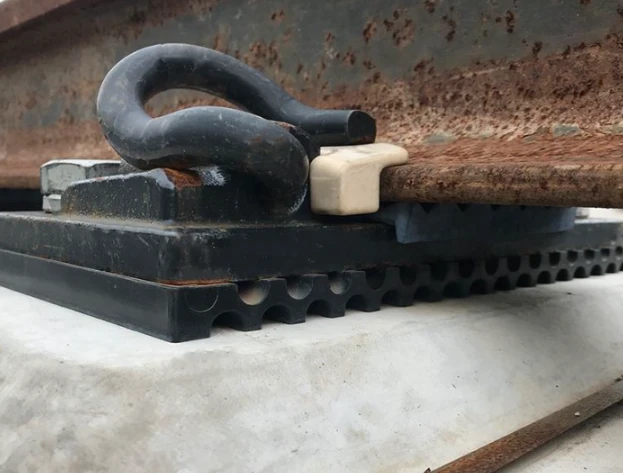
The working mechanism of a rail rubber pad relies on two key principles. First, its elastic compliance absorbs shock and impact loads from passing trains, reducing the peak forces transmitted to the substructure. Second, it dampens resonant vibrations in concrete sleepers-typically around 200 Hz-and accommodates small vertical rail deflections between supports, with amplitudes of about 0.12 mm at frequencies near 1000 Hz. This dual action prevents rail-sleeper abrasion and protects concrete sleepers from crushing under repeated wheel loads.
Design Principles and Structural Features
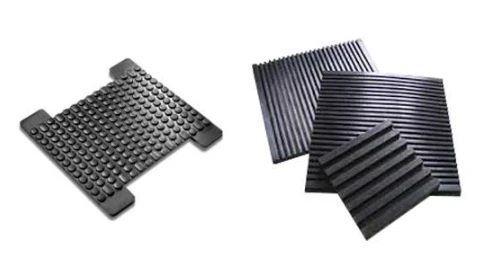
Rail rubber pads are engineered with a deliberately low initial stiffness to ensure close contact with the rail base even under vertical rail movement, maintaining consistent performance as trains pass. Grooves are often molded into the pad surface to achieve the desired load-deflection curve: the low initial stiffness keeps the pad seated under clip toe loads, while higher stiffness under full wheel load prevents excessive movement that could loosen fastening clips. Grooved designs also help store small amounts of lubricant in conventional railway applications, reducing friction between the rail and pad.

For specialized applications, pads may feature studded surfaces, hollow cores, wave patterns, or inverted trapezoidal profiles. High-speed rail and metro systems often use 20–30 mm thick special-shaped pads with enhanced elasticity, while conventional railways typically use 8–12 mm flat grooved pads. Crane rail pads range from 5–20 mm in thickness, with some multi-layer composite designs incorporating steel mesh cores for increased rigidity under heavy wheel loads. Crane rail pads may also have diamond patterns or grooves to improve anti-slip performance between the rail and foundation.
Materials and Mechanical Properties
Rail rubber pads are produced from a variety of materials selected to match specific application requirements. Natural rubber is the most common base material, valued for its high elasticity and resilience. Synthetic rubbers such as SBR offer excellent wear resistance at a cost-effective price point, while EPDM provides enhanced resistance to heat, weathering, and oil. NBR delivers superior oil and chemical resistance, and HNBR is used in high-speed rail applications for its exceptional thermal stability. High-speed rail pad compounds often blend natural rubber with SBR, precipitated silica, and anti-aging agents to reduce rolling resistance and extend service life.
Standard rubber rail pads have a stiffness of 90–130 kN, a hardness of 72–80 Shore A, tensile strength before aging of at least 12.5 MPa, and elongation before aging of at least 250%. EVA pads, composed of 80% polyethylene and 20% vinyl acetate, have a density of 0.95 g/cm³, tensile strength of at least 15 MPa, elongation greater than 500%, and insulation resistance of at least 1×10^10 Ω. HDPE pads offer a density of 0.95 g/cm³, tensile strength of at least 19 MPa, and hardness of at least 98 Shore A. All these materials provide reliable electrical insulation, a key requirement for railway signaling systems.
| Raw Material | Rubber,EVA,TPEE,HDPE |
| Standard | UIC,AREMA,TB/T2626-95 |
| Application | 43kg/m, 50kg/m, 60kg/m, 75kg/m,115RE,UIC54,UIC60,S49 |
| Model number | 43-7-7, 43-10-7, 50-7-9, 50-10-9, 60-10-17, 60-12-17 |
| Operating temperature | -50~70 degrees |
| Certificate | MSDS,ROHS,REACH |
| Notes | They should be stored in clean, ventilated place. Don't be direct sunlight, keep away from heat source and chemical reagent. Don't touch the oil, organic solvent and other chemicals. Banned exposure. |
Standards, Applications, and Compatibility
Rail rubber pads comply with a wide range of international standards, including UIC, AREMA, TB/T 2626-95, RDSO, DIN, ISCR, GB, VALEC, GOST-EASC, and other regional specifications. They are compatible with major fastening systems such as E-type, SKL, KPO, Nabla PR, Russian, and Fastclip systems, and fit rail profiles including 43 kg/m, 50 kg/m, 60 kg/m, 75 kg/m, 115RE, UIC54, UIC60, S49, and QU series crane rails.
In E-type fastening systems, the rail pad works alongside e-clips, rail insulators, and rail shoulders to insulate the rail from the sleeper and reduce vibration and structure-borne noise. In SKL systems, the pad's defined stiffness increases the overall elasticity of the track superstructure, contributing to quieter train operation and meeting strict acoustic requirements.

Rail rubber pads are used across tram lines, standard-gauge railways, heavy-haul lines, high-speed rail networks, metro systems, and crane track installations. For crane applications, pads are installed between the rail and supporting structure in workshops, ports, and storage yards, where they absorb vertical impacts and horizontal thrusts from frequent crane start-stop cycles, reduce fatigue damage to the rail and foundation, and compensate for minor foundation unevenness.
Selection and Installation Guidelines
Selecting the right rail rubber pad depends on track type, load conditions, and performance requirements. Thicker pads provide greater cushioning and insulation but increase track height, which may create clearance issues or require speed reductions. Thinner pads maintain a lower profile but transmit more noise and vibration. Conventional railways typically use 8–12 mm flat grooved pads, high-speed rail and metro systems use 20–30 mm special-shaped pads, and crane rail pads are 5–20 mm thick, adjusted based on wheel load.
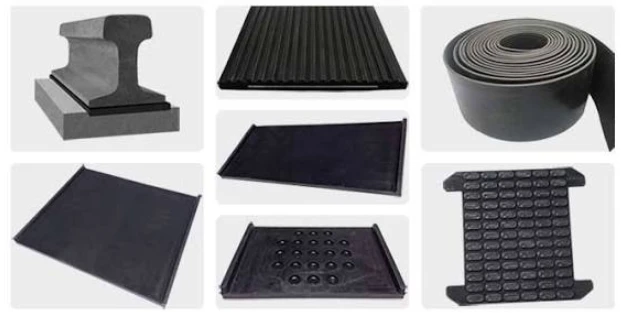
Shape is another key consideration: rectangular pads are used for straight track sections, while trapezoidal pads are designed for curved track. Pads may be supplied as individual units or continuous strips, depending on the system design. Fully customized dimensions, hardness levels, surface textures, and mounting hole patterns are available to meet specific project needs.
Proper installation ensures optimal pad performance. The supporting area must first be cleaned of oil and debris, then the pad is laid flat on the support. The rail is positioned on top of the pad, and the fastening system-including clips, washers, and nuts-is installed and tightened to the torque specified in the product datasheet. For clip-type fasteners, the clip body is tapped into position with a hammer to ensure metal-to-metal contact with the rail base before final torque is applied.
GNEE RAILWAY RAILWAYWAY supplies a full range of rail rubber pads compatible with global rail standards and fastening systems, with strict quality control covering compression performance, elasticity, and dimensional accuracy. Mill Test Certificates are provided with every shipment to verify material properties and traceability.
FAQ
- What is the difference between a standard rail rubber pad and a crane rail rubber pad?
Standard rail rubber pads are designed for passenger and freight railway systems, with typical thicknesses of 8–30 mm and formulations optimized for vibration damping and electrical insulation. Crane rail pads are engineered for heavy wheel loads and frequent start-stop cycles, with thicknesses of 5–20 mm and optional steel-reinforced multi-layer structures to handle high compressive forces. Crane pads also often feature anti-slip surface patterns and oil-resistant materials for industrial environments.
- How do I choose the right thickness of rail rubber pad for my project?
Pad thickness is selected based on track type, load requirements, and clearance constraints. Thicker pads (20–30 mm) are used for high-speed rail and metro systems where maximum vibration and noise reduction are needed. Conventional railways typically use 8–12 mm pads to balance cushioning with track height stability. For crane tracks, thickness ranges from 5–20 mm, adjusted according to wheel load-heavier loads require thicker or reinforced pads.
- What standards do GNEE RAILWAY RAILWAYWAY rail rubber pads comply with?
GNEE RAILWAY RAILWAYWAY rail rubber pads meet a wide range of international and regional standards, including UIC, AREMA, TB/T 2626-95, RDSO, DIN, ISCR, GB, VALEC, and GOST-EASC. They are compatible with all major rail profiles and fastening systems, from E-type and SKL clips to KPO, Nabla PR, and Fastclip systems. Each batch undergoes strict quality testing for compression performance, elasticity, and dimensional accuracy.
- Can rail rubber pads be customized for special track applications?
Yes, rail rubber pads can be fully customized in dimensions, hardness, material formulation, surface texture, and mounting hole patterns to match specific project requirements. Custom options include grooved or studded surfaces, special shapes for curved track or high-speed systems, and composite structures with steel reinforcement for heavy-load crane applications. Custom sizes are available for non-standard rail profiles or unique fastening system designs.


