What is the difference between a standard rail rubber pad and a crane rail rubber pad?
Sep 16, 2026

What is the difference between a standard rail rubber pad and a crane rail rubber pad?
Standard rail rubber pads and crane rail rubber pads differ primarily in design load capacity, structural composition, thickness range, and application scenarios, as each is engineered to match the specific operating conditions of its track system.
Standard railway pads for conventional lines typically have a hardness of 72–80 Shore A stiffness of 90–130 kN, with thicknesses ranging from 8–12 mm for flat grooved designs, while crane rail pads use thicker, reinforced structures (5–20 mm, with multi-layer composite options for long-span cranes) to handle high wheel pressures and frequent start-stop cycles. Standard pads are installed between rails and concrete sleepers for mainline railways, metros, and high-speed lines, whereas crane rail pads sit between crane rails and supporting steel or concrete structures in ports, workshops, and storage yards.
Core Design and Structural Differences
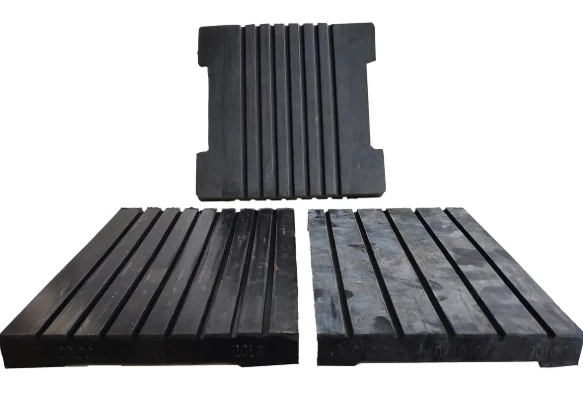
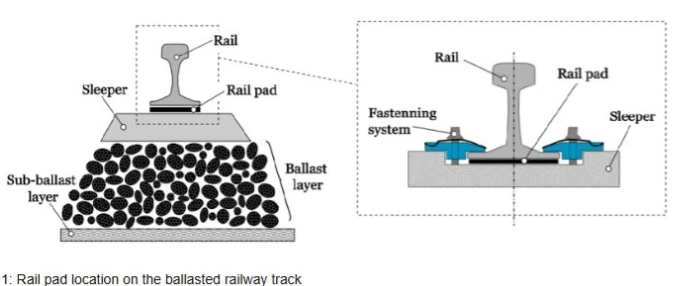
Standard rail rubber pads are designed to distribute train wheel loads across sleeper surfaces, reduce resonant vibrations in concrete ties, and provide electrical insulation for railway signal systems. Most standard pads feature grooved surfaces to achieve the required load-deflection characteristic: low initial stiffness ensures intimate contact with the rail during vertical movement, while sufficient working stiffness prevents excessive displacement that could loosen spring clips. For high-speed rail and metro applications, standard pads may take special shapes such as inverted trapezoids or wave patterns with hollow cores, reaching thicknesses of 20–30 mm to meet strict noise and vibration control targets. Standard pads are compatible with common fastening systems including E-type, SKL, KPO, Nabla PR, and Fastclip, and fit rail profiles from 43 kg/m up to 75 kg/m, as well as UIC54, UIC60, and 115RE sections.
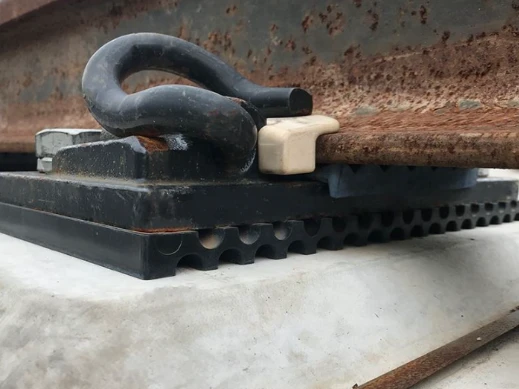
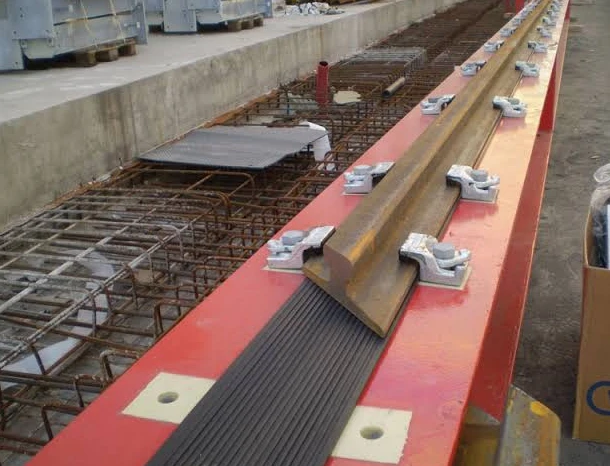
Crane rail rubber pads, by contrast, are built to withstand the extreme, concentrated wheel loads of overhead cranes, gantry cranes, and similar heavy industrial equipment. Many crane rail pads have a slightly convex cross-section to distribute force more evenly across the contact area, and some incorporate an embedded steel plate in the middle to increase pressure resistance and extend service life. For long-span cranes, multi-layer composite structures with rubber and steel mesh cores are used to deliver enhanced rigidity under repeated heavy loads. The surface of crane rail pads often features diamond patterns or grooves to increase friction with both the rail and the foundation, preventing slip during crane acceleration, braking, and turning. Standard crane rail pads are produced in 12 m lengths, with widths matched to rail base dimensions for QU series crane rails and other industrial rail profiles.
Material Formulation and Performance Priorities
Standard rail rubber pads are commonly made from natural rubber, synthetic rubbers such as SBR and EPDM, or alternative materials including EVA, HDPE, and TPEE. Natural rubber blends offer high elasticity and good vibration damping, while EPDM provides improved resistance to heat, weathering, and outdoor exposure. EVA pads are lightweight and flexible, with an elongation of over 500%, making them suitable for applications requiring high impact absorption. HDPE pads deliver high hardness (≥98 Shore A) and excellent electrical insulation, with insulation resistance reaching 3.5×10^10 Ω. All standard rail pad materials are formulated to operate within a temperature range of -50 ~ 70 °C, supporting reliable performance in diverse outdoor railway environments.
| Mechanical properties of the Rubber Rail Pad | ||
| Technical Parameter | Unit | Value |
| Stiffness | KN | 90-130 |
| Hardness Shore A | ℃ | 72-80 degree |
| Electronic Resistance | Ω | ≥ 106 |
| Tensile Strength before Aging | Mpa | ≥12.5 |
| Elongation before Aging | % | ≥250 |
Crane rail rubber pads use synthetic rubber blends optimized for compressive strength, wear resistance, and tolerance to industrial contaminants. The primary formulation combines natural rubber with NBR for oil resistance, carbon black for reinforcement, and vulcanizing agents to increase crosslink density. PU composite rubber is also used in certain crane applications for superior wear resistance under heavy, frequent loading. Crane rail pads are engineered to resist water, oil, grease, mildew, and fungus, addressing the common conditions of indoor workshops, port yards, and storage facilities where oil spills, dust, and temperature fluctuations are frequent. This specialized material formulation helps crane rail pads absorb both vertical impacts and horizontal thrusts generated during crane operation, reducing fatigue damage to rails and supporting structures.
Functional Differences in Track Systems
Standard rail rubber pads serve six core functions in railway track systems: load distribution over a larger surface, elimination of load concentration and resultant fatigue stresses, centering of loads on supporting elements, absorption of uneven contact surfaces between rail and support, reduction of noise and vibration, and sealing between the rail bottom and support top. They also prevent rail-sleeper abrasion and crushing of the sleeper under the rail foot, while providing electrical insulation required for railway signaling. In E-type fastening systems, standard pads work with e-clips, rail insulators, and rail shoulders to form a complete elastic assembly. In SKL fastening systems, the defined stiffness of standard pads increases track superstructure elasticity, contributing to quieter rolling stock operation and meeting acoustic requirements.
Crane rail rubber pads focus on three core functions tailored to industrial crane operations: shock absorption and vibration damping, leveling and conformity, and noise and wear reduction. They absorb vertical impacts and horizontal thrusts from crane starting, stopping, and turning, reducing fatigue damage to both the steel rail and the underlying concrete beam or steel structure foundation. By compensating for minor unevenness in the rail foundation, crane rail pads ensure close contact between the rail and base, preventing localized stress concentration that could lead to premature structural failure. They also lower metal-to-metal friction noise and minimize direct wear between the rail and foundation, reducing overall crane runway maintenance requirements and extending the service life of crane wheels, bearings, and axles.

GNEE RAILWAY RAILWAYWAY supplies both standard rail rubber pads and crane rail rubber pads with full quality traceability, including compression performance testing and elastic property verification for every batch. Mill Test Certificates are provided with all shipments, and third-party inspection can be arranged to meet project-specific quality requirements.
FAQ
- What is the typical hardness range for standard rail rubber pads?
Standard rail rubber pads generally have a hardness of 72–80 Shore A, with a stiffness of 90–130 kN. Alternative materials such as HDPE offer higher hardness of ≥98 Shore A for applications requiring greater rigidity and electrical insulation. The specific hardness is selected based on track type, load conditions, and required vibration damping performance.
- Can crane rail rubber pads be used for standard railway tracks?
Crane rail rubber pads are not recommended for standard railway tracks, as their material formulation and structural design are optimized for high wheel pressures and low-speed, frequent start-stop operation rather than the high-speed vibration and electrical insulation requirements of mainline railways. Standard rail pads are specifically engineered to match the dynamic characteristics of train travel and railway signaling systems. For best performance, always select pads designed for your specific track application.
- What materials are available for rail pads from GNEE RAILWAY RAILWAYWAY?
GNEE RAILWAY RAILWAYWAY supplies rail pads made from rubber, EVA, HDPE, TPEE, and polyurethane, with rubber pads primarily composed of natural rubber, styrene, chloroprene, and HDPE blends. For crane rail applications, synthetic rubber blends with NBR, carbon black, and vulcanizing agents are used, with PU composite options available for enhanced wear resistance. Custom material formulations can be developed to meet specific project requirements.
- How do I choose the right thickness for my rail pad application?
For conventional railways, flat grooved pads of 8–12 mm are standard, while high-speed rail and metro systems typically use 20–30 mm special-shaped pads for increased vibration damping. For crane track systems, pad thickness ranges from 5–20 mm, adjusted based on wheel load and mounting type. Thicker pads provide more cushioning but increase track height, so selection should balance performance requirements with clearance and speed constraints.