


What Materials Compose Railway Rail Guide Plates?
Nov 10, 2025
The material selection of Railway Rail Guide Plates (railway gauge baffles) directly determines their load-bearing capacity, durability, and adaptability. They are mainly categorized into metal materials and non-metallic materials, with all materials required to comply with international and domestic industry standards such as UIC, AREMA, BS, and GB to ensure synergistic stability with the track fastener system.

Metal materials are the most widely used category. Among them, Q235 ordinary carbon structural steel is the preferred choice for basic models due to its high cost-performance ratio. With chemical compositions of C≤0.22%, Mn≤1.4%, and Si≤0.35%, it has a tensile strength of 370-500MPa and excellent cold bending performance. Processed by hot rolling, it can meet the daily load-bearing requirements of ordinary railway lines. 65Mn spring steel, with higher strength, hardness, and elasticity, is suitable for heavy-haul sections with high demands for wear resistance and impact resistance. Medium carbon steels such as C35 and C45 have further optimized strength and toughness after heat treatment, making them common materials for mid-to-high-end gauge baffles. Ductile iron also occupies an important position: QT500-7 has a Brinell hardness of 180-220HB and a tensile strength of ≥500MPa, suitable for freight and ordinary passenger lines; QT600-3 has an increased hardness of 220-250HB and is often equipped with reinforcing rib structures to meet the harsh load requirements of high-speed railways or heavy-haul lines.
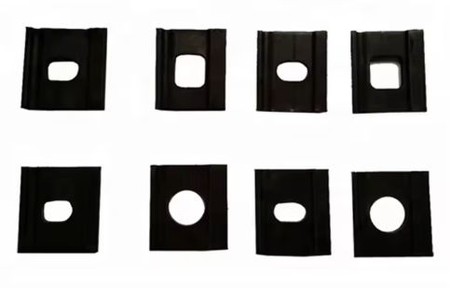
| Specifications | 6#, 10#, 14#, 20#, etc. |
| MOQ | 100 sets |
| Material | Q235, 65Mn, C35, C45, etc |
| Surface Treatment | Plain, Oxide Black, Sherardizing, Nitriding, Dacromet, Galvanized and Sherardizing Nickel or other upon requirements |
| Standard | UIC, AREMA, BS, RDSO, DIN, JIS, ISCR, GB, VALEC, GOSTR- EASC, GB/T or other upon requirements |
| Application | Type I rail fastener system, type II rail fastener system |
| Packaging Detail | Woven bag, Box, or other upon requirements |
| Delivery Time | 20-30 working days |
| Material | Chemical composition/%, | Tensile test, not less than | Cold bending test 180°, B=2a | ||||||
| not more than | |||||||||
| C | Mn | Si | S | P | ReH/ MPa | Rm/ MPa | A/% | Bending diameter d | |
| Q235A | 0.22 | 1.4 | 0.35 | 0.045 | 0.045 | 235 | 370~500 | 26 | a (longitudinal) |
| Q235B | 0.2 | 1.4 | 0.35 | 0.045 | 0.045 | 235 | 370~500 | 26 | a (longitudinal) |
Non-metallic materials are mainly reinforced nylon. Materials such as PA6+GF30 and PA66, after adding 30% glass fiber, have significantly improved mechanical strength, wear resistance, and insulation performance. They are specifically designed for track sections with special insulation requirements to avoid track circuit interference.
GNEE provides a full range of Railway Rail Guide Plates covering all the above materials, including multiple specifications and models such as 3#, 6#, 10#, 13#, 14#, and 20#, which can accurately match various fastener systems (Type Ⅰ, Type Ⅱ, Type Ⅲ, etc.) and rails of 43-75kg/m. Meanwhile, GNEE supplies complete supporting fasteners such as elastic rail clips, sleeper bolts, and railway plastic dowels, adhering strictly to international quality standards in production. It also offers customized solutions based on different line working conditions, along with professional installation technical guidance and long-term maintenance consulting services, providing one-stop and full-life-cycle fastening supporting services for track engineering.


