Can crane rail rubber pads be used for standard railway tracks?
Sep 16, 2026

Can crane rail rubber pads be used for standard railway tracks?
Crane rail rubber pads can be adapted for use on standard railway tracks, but they are not a direct one-to-one replacement for standard railway rubber pads due to differences in design parameters, thickness ranges, and load-bearing characteristics. Standard railway rail pads typically range from 8–12 mm in thickness for conventional lines and 20–30 mm for high-speed or metro systems, while crane rail pads are designed in 5–20 mm thicknesses tuned for high wheel pressures and frequent start-stop cycles of overhead and gantry cranes. When properly selected for load, stiffness, and rail profile compatibility, crane rail rubber pads can deliver effective vibration damping and wear protection in certain standard track applications.
Core Differences Between Crane Rail Pads and Standard Railway Rail Pads
To understand the compatibility of crane rail rubber pads with standard tracks, it is first necessary to clarify their respective design priorities.
Standard railway rubber pads, also referred to as rail pads or railway pads, are engineered to distribute train wheel loads across concrete sleepers, reduce resonant vibrations in concrete ties at frequencies around 200 Hz, and provide electrical insulation for railway signal systems. They are manufactured to meet standards such as UIC, AREMA, and TB/T 2626-95, and are available for common rail profiles including UIC54, UIC60 (also referenced as 60E1), 115RE, and 43–75 kg/m sections. Grooved designs are widely used on conventional lines to deliver low initial stiffness, ensuring the pad maintains intimate contact with the rail base during vertical movement while providing sufficient rigidity under wheel load to prevent clip loosening.

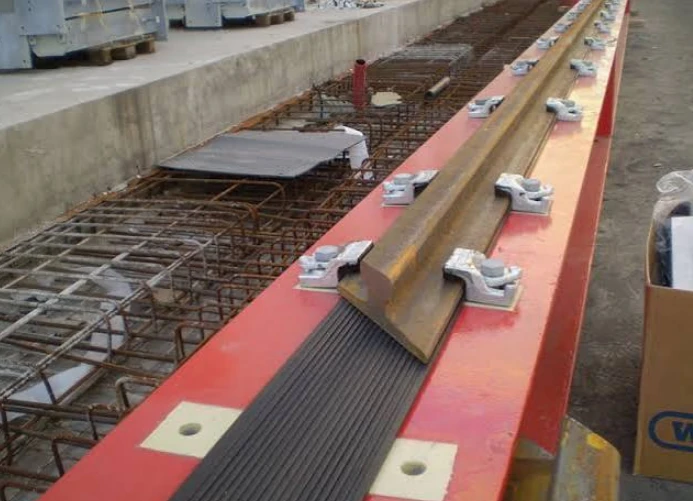
Crane rail rubber pads, by contrast, are built for heavy industrial crane runways in workshops, ports, and storage yards. These environments feature low-speed operation, extremely high wheel pressures, and frequent start-stop and turning cycles that generate both vertical impact and horizontal thrust. Crane rail pads often incorporate embedded steel plates or multi-layer rubber-and-steel-mesh composite structures to handle higher compressive loads, and their surfaces may feature diamond patterns or grooves for increased anti-slip friction between the rail and foundation. Standard crane rail pad widths are matched to crane rail bases such as QU70, QU80, QU100, and QU120, with PA7-series pads representing one common product line sized for these profiles.
-
Application Scenarios Where Crane Rail Pads Work on Standard Tracks
Crane rail rubber pads are most suitable for standard railway tracks in low-speed, heavy-load industrial settings rather than mainline passenger or high-speed routes. Typical suitable applications include port access tracks, heavy industrial plant sidings, freight yard classification tracks, and maintenance facility tracks where axle loads are high but operating speeds are low. In these scenarios, the high compressive strength and wear resistance of crane rail pads can extend service life and reduce maintenance frequency compared to standard pads that may wear faster under heavy, repeated impact loads.

For mainline standard-gauge railways, high-speed lines, and metro systems, dedicated standard railway rail pads remain the recommended choice. These pads are precision-engineered to control vibration, reduce structure-borne noise, maintain gauge accuracy within ±2 mm, and support the specific dynamic behavior of high-speed rolling stock. Special-shaped pads with hollow cores, wave patterns, or inverted trapezoidal profiles are used in CRTSⅢ ballastless track and similar systems, and these designs are not typically available in crane rail pad product lines.
GNEE RAILWAY RAILWAYWAY supplies both standard railway rail pads and crane rail pads across a full range of materials, profiles, and fastening system compatibilities, with strict quality control covering compression performance, elasticity, dimensional accuracy, and hardness testing. Mill Test Certificates are provided with every shipment to ensure full traceability of material and performance data.
FAQ
- Can I use a crane rail rubber pad directly on a UIC60 standard railway track?
A crane rail rubber pad cannot be used directly on a UIC60 track unless its width, thickness, and stiffness are specifically matched to the UIC60 rail foot and the applicable fastening system. Standard UIC60 rail rubber pads are designed with precise load-deflection characteristics to work with UIC-standard fasteners and concrete sleepers. If a crane pad is selected with matching dimensions and a stiffness within the 90–130 kN range typical for railway rubber pads, it may be adapted for use on low-speed standard tracks after verification.
- What is the main difference in hardness between crane rail pads and standard rail pads?
Standard railway rubber pads typically have a hardness range of 72–80 Shore A, tuned to balance vibration damping and load distribution for passenger and freight trains. Crane rail pads may use harder rubber compounds or incorporate steel reinforcement to handle the concentrated wheel loads of overhead and gantry cranes. When selecting a crane pad for standard track use, confirm that its rail pad hardness falls within the required range for your track class and fastening system.
- Are crane rail pads suitable for high-speed standard railway lines?
Crane rail pads are not recommended for high-speed standard railway lines, as they are not engineered to control the specific resonant frequencies and dynamic deflections associated with high-speed operation. High-speed lines require special-shaped pads 20–30 mm thick with carefully optimized elasticity to reduce vibration, control noise, and maintain precise track geometry. Crane rail pads generally top out at 20 mm thickness and lack the specialized profile designs used in high-speed and metro track systems.
- In what standard track applications do crane rail rubber pads perform well?
Crane rail rubber pads perform well on low-speed, heavy-load standard tracks such as industrial sidings, port access lines, freight yard tracks, and workshop spurs. These applications feature high axle loads, frequent slow-speed movement, and exposure to oil and dust-conditions where the high compressive strength, abrasion resistance, and oil resistance of crane rail pads provide a durability advantage. For mainline passenger or high-speed service, dedicated standard railway rail pads remain the appropriate choice.
- Do crane rail pads meet the same international standards as standard railway pads?
Crane rail pads are primarily sized and tested for crane runway applications, and they do not automatically carry the same railway-specific standard certifications as standard rail pads. Standard railway pads conform to UIC, AREMA, TB/T, DIN, and other railway standards, and are validated for compatibility with E-type, SKL, KPO, Nabla, and other railway fastening systems. Crane rail pads can be manufactured and tested to meet railway standard requirements on a custom basis for specific retrofit or industrial track projects.