


What are the maximum temperatures that rail pads can withstand?
Dec 19, 2025
The rail pad, also known as bottom plate, is an elastic polyurethane pad assembled between the rails and sleeper to protect the top of the sleeper from wear and impact. The initial stiffness of the rail pad is not so high that the deformation of the rails under the load of the spring is very large. This mechanism ensures that the rail pad moves as close as possible to realize close contact with the track.
What are the maximum temperatures that rail pads can withstand?
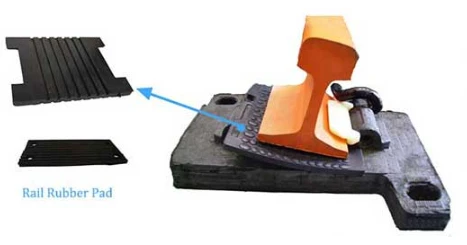
Rail pads typically withstand temperatures from around -25°C to +100°C (or 120°C short-term) for standard synthetic rubbers, but can go higher with specialized materials like graphite or silicone (up to 150°C, even 200°C/300°C for some high-temp types), designed for extreme heat in metallurgy or industrial settings, though most standard railway pads stick to the -25°C to 100°C range for consistent performance.
What are the effects of high temperatures on rail pads?

High temperatures primarily cause rubber rail pads to soften, reducing stiffness and vibration isolation, leading to increased rail vibration and noise, while some composites maintain better performance, but all pads can experience issues like compression set (permanent deformation), decreasing their cushioning, ultimately impacting track health, noise, and ride quality, especially if they lose elasticity.
How can rail pads be made to function properly at high temperatures?
To make rail pads function at high temperatures, can use advanced materials like Hydrogenated Nitrile Rubber (HNBR) for superior heat resistance, blend rubbers with additives (silica, anti-agers), design special structures (hollow cores, metal mesh), and incorporate composite materials (cork-rubber) for better stability, ensuring pads maintain elasticity, shock absorption, and prevent failure in extreme heat.
Different reactions of rail elastic pads made of different materials at high temperatures

At high temperatures, rail pads' performance varies by material: standard rubber softens, losing stiffness and vibration damping; cork-rubber offers better stability, maintaining stiffness and damping; while EVA pads can get stiffer but may degrade or stiffen excessively, impacting noise and track forces, highlighting how different polymers and composites react to heat, affecting stiffness, damping, and overall track performance.
| Raw Material | Rubber, EVA, TPEE, HDPE |
| Standard | UIC, AREMA, TB/T2626-95 |
| Application | 43kg/m, 50kg/m, 60kg/m, 75kg/m,115RE, UIC54, UIC60, S49 |
| Model number | 43-7-7, 43-10-7, 50-7-9, 50-10-9, 60-10-17, 60-12-17 |
| Operating temperature | -50~70 degrees |
| Certificate | MSDS, ROHS, REACH |
| Notes | They should be stored in a clean, ventilated place. Don't be in direct sunlight, and keep away from the heat source and chemical reagent. Don't touch the oil, organic solvent, and other chemicals. Banned exposure. |
As a professional rail fastener manufacturer, GNEE RAIL can produce various types of rubber rail pads with different materials, such as natural rubber, EVA, HDPE and so on.


