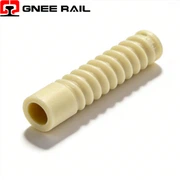
What type of Rail Pad is used for 60KG rails?
Nov 25, 2025
What type of Rail Pad is used for 60KG rails?
A rubber rail pad is used for 60kg rails, typically made of natural rubber with a hardness of 75-85 shores A. These pads are installed between the steel rail and the concrete sleeper to absorb shock, reduce noise, and prolong the life of the track infrastructure.
- Material: Natural rubber is the main material, often with a hardness of 75-85 shores A.
- Function: The pad's primary role is to protect the sleeper and the track bed from the high-speed vibrations and impacts of passing trains.

- Additional benefits: It provides electrical insulation, shock absorption, and low noise performance.
- Types: Specific models exist, often identified by a standard drawing number, such as RDSO Drawing No. T-3711 for 60KG UIC rail sections.
- Application: These pads are used in industrial applications, on concrete foundations, and on steel structure foundations.
The Following are Rubber Rail Pads Parameters:

| Type | Diameter(mm) | Weight(kg) | Material |
| WJ8-B | 285mm*150mm*12mm | 0.35kg | Thermoplastic elastomer |
| WJ8-6 | 175mm*160mm | 0.24kg | Premium natural rubber or synthetic rubber |
| P50 | 185mm*131mm*10mm | 0.29kg | Premium natural rubber or synthetic rubber |
| P60 | 185mm*151mm*10mm | 0.34kg | Premium natural rubber or synthetic rubber |
| WJ8-6 | 175mm*160mm | 0.24kg | Premium natural rubber or synthetic rubber |
Manufacturing Process

| • | Preparation of rubber compound |
| • | Mixing is carried out on a two-roll mill or in an internal mixer. In the case of an internal mixer, it can be done in a single-stage or double-stage mixing where the masterbatch, which was earlier prepared in the internal mixer, is finalized by adding curatives on a two roll mill. |
| • | Shaping and curing |
| • | Compression or Injection moulding |
| • | Trimming of finished products |
| • | Ready for use |
Rail pad functions
A rail rubber pad is essential in reducing shock and vibration in a rail system. The pad laid under the rail to ensure:
- Load distribution over a larger surface
- Elimination of load concentration and the resultant fatigue stresses
- Centering of loads on the supporting element
- Absorption of uneven contact surfaces between rail and support
- Reduction of noise and vibration
- Sealing between the bottom of the rail and the top of the support
- Reduction of wear of the rail and its support

Rail pad materials
We have developed a range of high-performance elastic rail pads for stiffness requirements and various application areas-from trams through standard gauge railways to heavy haul lines, especially those for E-type rail fastening systems and SKL type rail fastening systems with material of HDPE/EVA/Rubber, with following properties respectively.

| Rubber Rail Pad | ||
| Technical Parameter | Unit | Value |
| Stiffness | KN | 90-130 |
| Hardness Shore A | ℃ | 72-80 degree |
| Electronic Resistance | Ω | ≥ 106 |
| Tensile Strength before Aging | Mpa | ≥12.5 |
| Elongation before Aging | % | ≥250 |
| HDPE Rail Pad | |||
| Technical Parameter | Unit | Technical Requirement | Value |
| Density | g/cm3 | 0.95-0.98 | 0.95 |
| Tensile Strength | Mpa | ≥19 | 19 |
| Elongation | % | >80 | 150 |
| Melting Point | ℃ | 170-190 | 190 |
| Insulation Resistance | Ω | ≥1×10¹⁰ | 3.5 ×10¹⁰ |
| Hardness | A | ≥98 | 98(A) |
| EVA: Polyethylene 80%, Vinyl Acetate 20%. | |||
| Technical Parameter | Unit | Technical Requirement | Value |
| Density | g/cm3 | 0.95-0.98 | 0.95 |
| Tensile Strength | Mpa | ≥15 | 16 |
| Elongation | % | >500 | 550 |
| Melting Point | ℃ | 170-190 | 170 |
| Insulation Resistance | Ω | ≥1×10¹⁰ | 5.0 ×10¹⁰ |
| Hardness | A | ≥90 | 92(A) |
As a professional rail fastener manufacturer, GNEE RAIL can produce various types of rubber rail pads with different materials, such as natural rubber, EVA, HDPE and so on. Our EVA/HDPE/rubber rail pads are with high elasticity, applying to types for rails such as rail UIC54, UIC60, BS80lbs,BS100lbs, and sizes as ordered. The pads can be customized with or without grooves, in various possible designs, depending on customers' requirements.